Posted on August 13th, 2014
 By DERON SNYDER
Once again, it’s time to check off some items on my “TIDU List” – Things I Don’t Understand:
*How we know which quarterback will be better long-term.
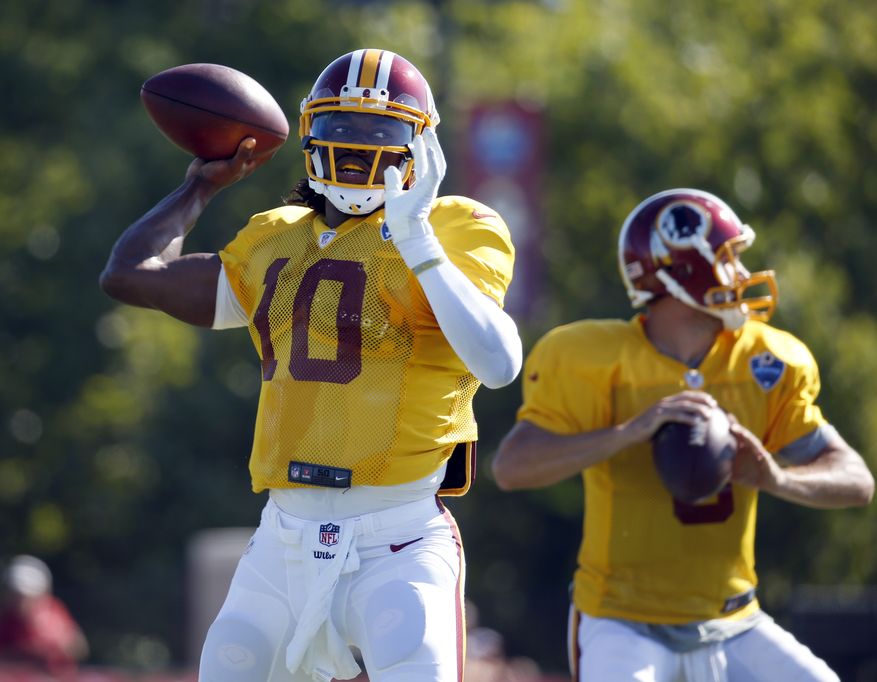
There’s no controversy because Washington yielded several firstborns for Robert Griffin III and he won Rookie of the Year. Kirk Cousins is a fourth-rounder with a 1-3 record as a starter. It won’t be here, but eventually Cousins will be a No. 1 and show how he compares. If Griffin can’t progress as a pocket passer or stay healthy, who knows?
Put your money on RG3, but don’t bet the house.
*Why more coaches aren’t truthful about dishonesty.
Asked about recruiting, West Virginia’s Dana Holgorsen told reporters Monday, “… I know you lie in recruiting a bunch, and that’s just part of it. You become a salesman. … Our job is to get guys on campus.” Later, a spokesman said the coach was joking. It didn’t sound like one, but thanks for clearing that up!
Next time a coach says he’ll never leave, we’ll still believe him.
*How the Wizards won’t have a merry Christmas.
Playing the Knicks on Dec. 25 instead of enjoying the holiday like most of us won’t be all bad, because it cements the Wizards’ arrival as a near- marquee team. John Wall/Brad Beal on the U.S. men’s team would’ve raised the Wizards’ national profile even higher, but winning in the playoffs and adding Paul Pierce have done the job just fine.
Besides, playing my beloved, hometown Knicks is almost a guaranteed win.
Read more…
Posted on August 11th, 2014

Tony Stewart confronts Matt Kenseth in 2012.
By DERON SNYDER
The first TV story that caught my eye Sunday morning, before I absorbed the scroll about a racing accident in upstate New York, was about a guy named Lonnie Bissonnette.
He recently celebrated the 10th anniversary of his BASE jump off the Perrine Bridge, in Twin Falls, Idaho, by returning to the scene for another leap. Except this time he was in the wheelchair he’s been in ever since the first visit left him paralyzed when his parachute malfunctioned.
Crazy, right? Whatever it is that causes someone to voluntarily fling himself off a structure 500 feet high, I’m glad it’s not contagious.
After watching Bissonnette’s successful jump – wheelchair and all – I focused on the news from Canandaigua, N.Y., where 20-year-old driver Kevin Ward Jr. was killed during a sprint car race. That sounded normal enough until realizing that Ward was a pedestrian when three-time NASCAR champion Tony Stewart struck him.
Auto racing is another extreme-type sport in which the thrill (and danger) of participation seems to be reward enough for competitors. We’ve come to accept the fact that death is a realistic outcome in such activities, whether it’s crashing to earth or crashing into a wall.
Though both sports require a person to be, you know, a little nuts by normal standards, BASE jumping lives primarily on YouTube. Auto racing is on cable and free TV constantly.
The loss of life on a racetrack is tragic under any circumstances, but this instance is particularly sad because it has nothing to do with racing, per se. Instead, it has everything to do with the macho, tough-guy posturing that exists in the sport’s undercurrent.
That’s what led Ward to leave his vehicle after a wreck and walk onto the track to express his displeasure with Stewart.
Read more…
Posted on August 7th, 2014
 By DERON SNYDER
Gregg Popovich and the San Antonio Spurs continue to make the rest of the NBA look bad.
That’s not the intention, though. It’s simply a result of doing their job to the best of their ability.
Overseas, the Spurs were at the forefront of international scouting, among the first organizations to capitalize on the vast, untapped potential in foreign talent. San Antonio broke its own record last season by employing 10 players born outside the U.S. They even made waves on the coaching staff last month, adding European legend Ettore Messina.
On the court, Popovich has built a well-oiled system that works beautifully with interchangeable parts. He was fined by former commissioner David Stern two years ago for sending four of the Spurs’ top five scorers home before a national TV game in Miami; the Heat needed a late three-pointer to eke out a narrow victory.
At the negotiating table, San Antonio has found a way to keep its Big Three happy and intact for more than 13 years. Tim Duncan, Tony Parker and Manu Ginobli have signed multiple contracts to their liking, while the team reserved enough money for a solid supporting cast at a reasonable price, creating a culture of “we’re-all-in-this-together.”
There wasn’t much more the Spurs could do to separate themselves from fellow NBA teams … unless you’re talking about winning more championships.
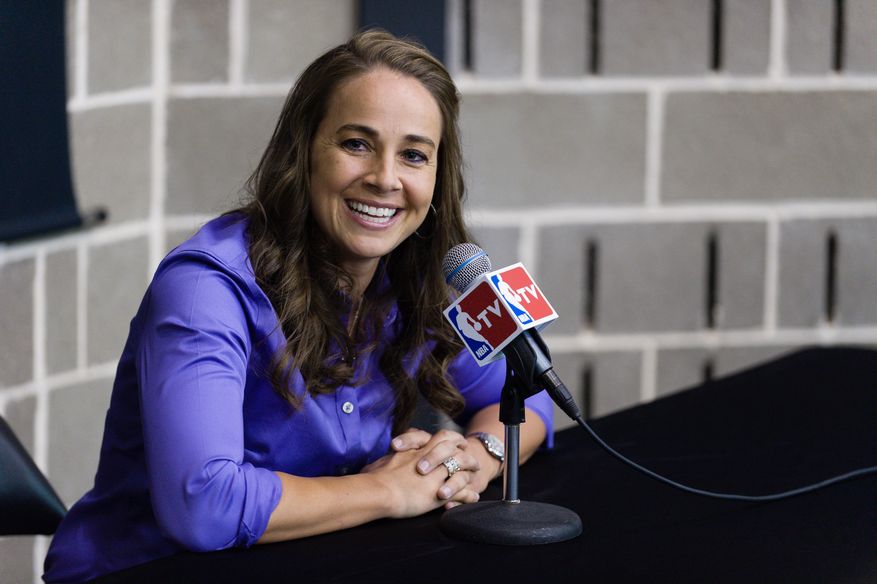
But like it or not, the franchise moved further from the pack Tuesday when it added Becky Hammon to the staff, making her the first female full-time assistant coach in NBA history.
It would be fantastic if we could look at Hammon’s credentials as a six-time WNBA All-Star and consider nothing else. Clearly she’s got game, named one of the league’s all-time Top 15 players in 2011, ranking fourth in assists, sixth in games and seventh in points on the career lists.
Surely that’s all Pop took into account. You sense that he would hire the first Martian assistant coach if it helped the cause. He didn’t mention Hammon’s gender in a press release because it’s irrelevant to him.
“Having observed her working with our team this past season, I’m confident her basketball IQ, work ethic and interpersonal skills will be a great benefit to the Spurs,” he said in a statement.
Read more…
Posted on August 4th, 2014
 By DERON SNYDER
Perception and reality are not always aligned, a fact that can lead to sweeping generalizations and stereotypes based on class, race and gender.
You know, like jocks are less-gifted in the classroom and fraternity members are hardcore drinkers. Both groups also have been known to display penchants for sexual harassment and/or assault.
They share that last trait with the military, which apparently creates a trifecta at the U.S. academies, where athletes form a fraternity-of-sorts amid their fellow future service members.
The latest case in point comes from an extensive investigation by the Colorado Springs Gazette, revealing that Air Force Academy cadets, “including a large a core of top football players, smoked synthetic marijuana, drank themselves sick and may have used date-rape drugs to incapacitate women for sexual assault” at parties dating to 2010.
Students at the Air Force Academy, West Point and the Naval Academy are supposed to be different. They’re supposed to adhere to honor codes and higher behavior standards befitting of officers in our armed forces.
It might not be the case on other college campuses, but “character” is supposed to be more than a cliché when you’ll don your country’s uniform upon graduation.
But according to the Gazette’s investigation – based on hundreds of pages of Air Force documents obtained under the Freedom of Information Act, as well as dozens of interviews – the academy’s culture was so wild, “leaders cancelled a planned 2012 sting out of concern that undercover agents and confidential informants at a party wouldn’t be enough to protect women from rape.”
Academy officials opened an investigation that looked into 32 cadets, including 16 football players and several other athletes. According to academy Superintendent Lt. Gen. Michelle Johnson, nine of the football players and 17 of the cadets overall never made it to graduation, either dismissed or resigning on their own.
Sad but true – we’d be less surprised at such a report if it came from a traditional football powerhouse in the Southeastern or Big 12 conferences.
We’re so accustomed to inappropriate and illegal activities at bastions of big-time college sports, we grow numb with each new tale. We have lumped and labeled the best athletes as walking time bombs, capable of going off at any moment and landing on the police blotter.
Read more…
Posted on July 31st, 2014
 By DERON SNYDER
Did you hear the news?
Kevin Durant is coming home!
Two years from now!
Maybe.
Unless the rampant speculation and search for clues kills us first.
Durant, a four-time NBA scoring champ and D.C. native, made waves Tuesday at Team USA’s training camp in Las Vegas. All it took was speaking openly and honestly about perhaps joining the Wizards as a free agent in 2016.
“Kevin Durant feels tug to return home to Washington after LeBron James’ decision,” read a headline on Yahoo Sports.
USA Today wondered, “Could Kevin Durant be the next NBA star to head home?”
ESPN noted what Wizards fans hope is a telltale sentiment: “Kevin Durant: LeBron move ‘classy.’”
Bleacher Report put it all together: “Stay or go? Two years out, Kevin Durant is already weighing his options.”
Can we survive 24 months of this? Just another dozen would be excruciating. And we have the easy part here in D.C.; imagine Oklahoma City’s rising angst.
Such conjecture is unavoidable in today’s micro-instant environment. The continuous news cycle demands to be fed and it’s hardly a picky eater.
Junk food is just fine.
It’s not Durant’s fault that folks in D.C. and OKC are getting worked up about something that might or might not happen two summers from now. It’s not his fault that he’s asked to predict his feelings and thoughts in 2016, with no knowledge of events that will transpire before then.
And you can’t blame him for speaking on the unknown. Keeping his mouth shut wouldn’t quell the fire because everyone else is fanning the flames.
“It’s being talked about,” Durant told reporters Tuesday after Team USA’s practice. “Everybody is asking me about it every time I go on Instagram or Twitter. All my friends ask me about it. I’m not going to sit here and act like I’m naïve to the fact that people think about that stuff.”
Read more…
Posted on July 29th, 2014
 By DERON SNYDER
There is no magic eraser.
Though we’d love to blot out certain actions and periods from our past, history is written in indelible ink. Pretending that something never happened, or ignoring its existence, doesn’t lead to progress.
Changed behavior and better decisions lead to progress.
Baseball today isn’t the same sport I covered fulltime from 1991-2000. Neither slugging statistics nor sluggers’ bodies are as big. It took an act of Congress and a rare concession from the players union, but the industry has moved beyond the Steroid Era.
However, our recollections remain. Not to mention the records.
Barry Bonds’ 73 homers. Roger Clemens’ last four Cy Young awards. The 136 round-trippers between Mark McGwire and Sammy Sosa in the Great Home Run Race of 1998.
Some fans sneer at the mention of those names – Bonds, Clemens, McGwire and Sosa – the era’s Four Horsemen. They’re the players who ruined baseball while simultaneously making it more popular, the cheaters who disgraced the game while making everyone involved richer.
But their feats will never go away and we’ll never forget, no matter how hard baseball wishes. We can’t look back on the sport and don a blindfold from the late ‘80s to the late 2000s. That period is as much a part of baseball as the Deadball Era and Segregation Era.
If Bonds and Clemens don’t belong in the Hall of Fame (maybe McGwire, too), we’re fooling ourselves in attempting to punish them.
“Treat them all the same,” former manager Tony La Russa told ESPN last week, prior to his induction Sunday. “If you were a Hall of Famer during that period as far as your pitching and playing, I would create some kind of asterisk, where everybody understands that, ‘Look, we have some questions, but you were still the dominant pitchers and players of your time.’
Read more…
Posted on July 23rd, 2014
 By DERON SNYDER
Not everyone is cut out to be a pioneer.
Thankfully, the role doesn’t require a horde of people.
Being at the forefront of unprecedented developments can be uncomfortable. The level of attention and scrutiny spikes like temperatures in July. Everywhere you go, the environment changes as soon as you arrive. Normalcy warps and cracks and becomes a distant memory.
After a while, though, firsts aren’t such a big deal.
Sure, they’re always honored for their roles. Their names are etched in stone and the history books. They are recognized for their feat as long as they live.
But as more folks follow suit, what once was considered bold, daring and shocking becomes the new norm.
By then, when the magnifying glass goes away and the spotlight goes out, it’s easier for the masses to join in and do the right thing, too.
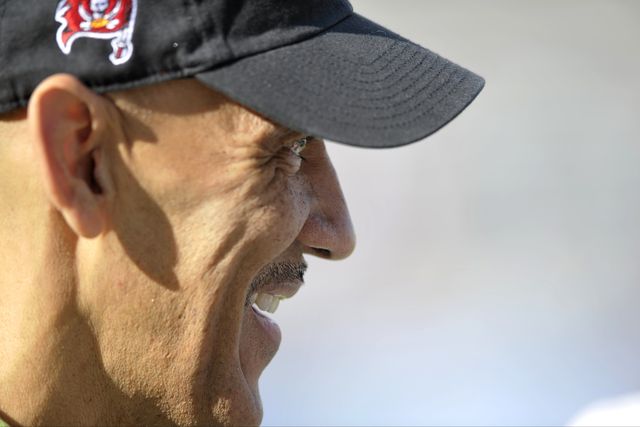
So we shouldn’t be overly harsh in judging Tony Dungy’s comments that he “wouldn’t want to deal with all of it,” and therefore wouldn’t have drafted openly gay NFL player Michael Sam.
It turns out that Dungy’s heart really is in the right place.
He simply isn’t pioneer material.
“… I felt drafting him would bring much distraction to the team,” Dungy said in a statement released Tuesday, attempting to quell the firestorm he ignited by earlier remarks to the Tampa Tribune.
Read more…
Posted on July 23rd, 2014
 By DERON SNYDER
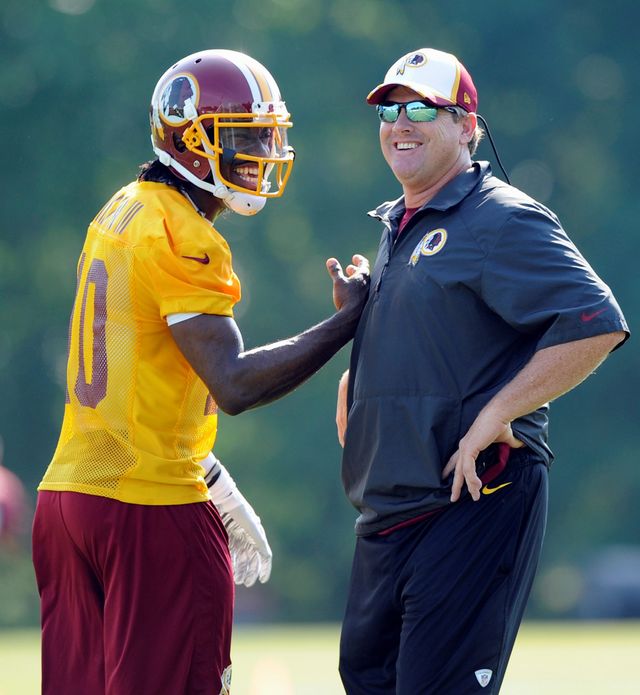
Year 1 of the Robert Griffin III-Jay Gruden Era is upon us. And like most newlywed couples, they look wonderful together.
Griffin is fully recovered from the knee injury that severely hampered his performance last season. He seems happier and more relaxed, partially due to the absence of a knee brace and partially due to the absence of coach Mike Shanahan.
Gruden is eager, energetic and enthusiastic, raring to start his first training camp as an NFL head coach. Son of a football lifer, brother of a Super Bowl-winning coach, Gruden is anxious to make his own mark under the family name.
Griffin and Gruden seem perfect for each other at this stage of their respective careers. They’re prime candidates to grow old and gray together – which is about 10 years for such duos – poised to join the ranks of Tom Brady-Bill Belichick, Eli Manning-Tom Coughlin, Drew Brees-Sean Payton and Ben Roethlisberger-Mike Tomlin.
Many thought Griffin and Shanahan were in it for the long haul, too, thought they could re-create the synergy that existed in Denver when the coach and John Elway won back-to-back Super Bowls together. Shanny was the old-school pro who would develop the budding star in RG3.
But Shanahan didn’t shape and mold the young QB.
He bent and nearly broke him instead. Shanahan might as well have been another defender delivering crushing blows as Griffin failed to slide.
Read more…
Posted on July 21st, 2014
 By DERON SNYDER
This is more like it. This is what we expected from the Washington Nationals all along, winning a pair here and three-of-a-kind there, settling in at the table with one of baseball’s best hands.
They misplayed their cards last year and have spent most of this season with less than a full deck. But they’re beginning to roll now, picking up in the second half where they left off at the All-Star break.
The Nationals embarked on a nine-game road trip following Sunday’s thrilling, walk-off victory against Milwaukee. They opened the second half by taking two-of-three from the Brewers and improved to 26-15 since June 1, 18-11 since June 15.
We haven’t seen that sort of sustained success since the tail end of last season, when they mounted a too-little-too-late push and failed to reach the playoffs. The Nats had set us up with their “World-Series-or-bust” attitude and everyone was crushed at the end.
The crash – along with the Washington Wizards’ playoff run and the huge interest in World Cup soccer – might explain the Nats’ precipitous dip in local TV viewership. According to Sports Business Journal, ratings in the D.C. market through the first week of July were down 34 percent from the same point last season. Only the Dodgers and Rangers had bigger drops.
Last year, fans were still heady off the 2012 joy ride, anticipating a much better ending than Game 5 of the Division Series against St. Louis. Washington was a near-consensus pick to win the pennant in 2013 and former manager Davey Johnson seconded that notion whenever asked about it – if he didn’t bring it up on his own.
Rookie manager Matt Williams is much more low-key, just like in his playing days, when he circled the bases with his head down after homering, as if embarrassed for the pitcher.
This skipper is less colorful but the Nats arguably are more compelling. Their enhanced competitiveness should result in more victories as well as viewers down the stretch. Considering that they reached first place in the NL East despite having their Opening Day roster intact for less than one month, they should pull ahead if health doesn’t derail them.
Read more…
Posted on July 15th, 2014
 By DERON SNYDER
If you’re irritated by the Derek Jeter Farewell Tour, weary of the accolades and tired of all the gift-giving, then you shouldn’t watch the All-Star Game. It might be downright sickening.
Then again, something’s wrong with you anyway if you begrudge these tributes for an all-time great player and ambassador.
We don’t know how, we don’t know who and we don’t know when. But the New York Yankees shortstop will be honored Tuesday night in his final All-Star Game. The players just have to think of something different than last year, when former Yankees closer Mariano Rivera wound up taking the field by himself and basking in a long round of applause.
Whatever recognition is bestowed on Jeter for his remarkable career, he certainly has earned it.
Time is catching up to the 40-year-old, who no longer resembles the tremendous player he’s been for two decades, but time can’t erase his five World Series championships, .311 career batting average and 3,407 hits. Selection to his 14th All-Star Game is based on lifetime achievement, not his pedestrian last go-round (.271 average).
Tuesday night will be the last chance for goodbyes on a national stage if the Yankees miss the playoffs again. There might not be another occasion to celebrate Jeter until his Hall of Fame election in 2020.
Hating the Yankees is a fulltime job for some fans, and this lovefest can’t be easy for them. They argue that Jeter’s legend is inflated due to his New York address. They contend that the fistful of World Series rings is due to the late George Steinbrenner’s checkbook. They insist that Jeter can’t be as angelic as the media portrays him.
There are grains of truth in those stances, but they’re washed away by a sea of evidence to the contrary.
Read more…
 Follow

 By DERON SNYDER