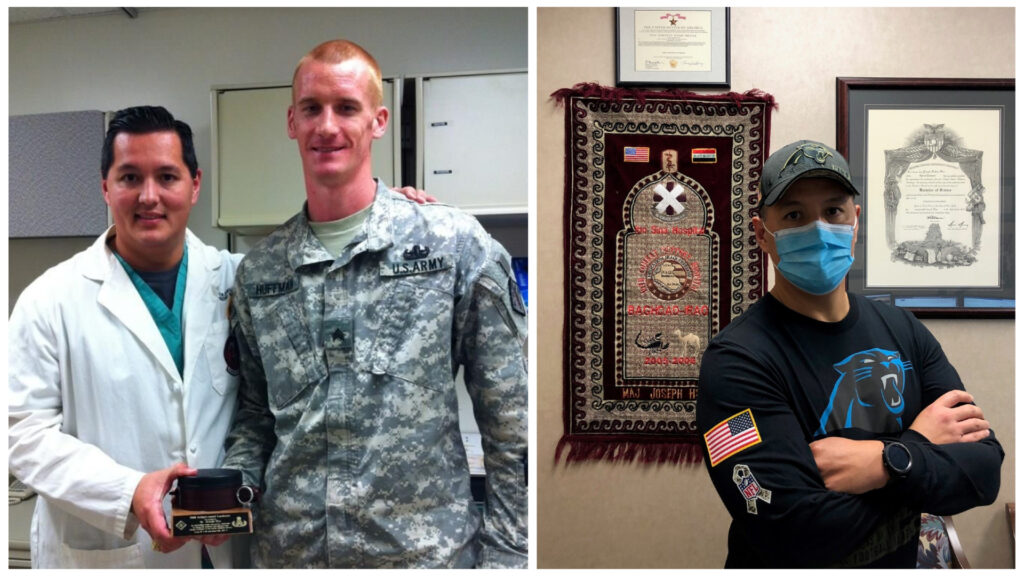
Joseph Hsu, MD, has a keen understanding of our veterans’ contributions to society. He graduated from the United States Military Academy at West Point. He then went on to serve in Iraq during some of American troops’ fiercest encounters with enemy forces. He has used his training and skill to help numerous veterans recover from their injuries. Through his dedicated years of service, he was even awarded the Bronze Star Medal – the fourth highest ranking award a service member can receive for a heroic and meritorious deed performed in conflict.
Dr. Hsu also sees a connection that perhaps many may overlook: the medical advances that civilians can enjoy as a result of veterans’ sacrifices. He thinks about it often, especially during the “NFL Salute to Service” campaign, which the Carolina Panthers will celebrate on Nov. 15 when they honor him and host the Tampa Bay Buccaneers.
“We are proud of our longstanding partnership with the Carolina Panthers and honored to celebrate and recognize members of the military as part of the NFL’s Salute to Service. Atrium Health is committed to extending appreciation to those who have previously served and those who are currently serving our country,” says Claude T. Moorman III, MD, president at Atrium Health Musculoskeletal Institute.
“I couldn’t be more honored to be part of ‘Salute to Service,’” says Dr. Hsu, an orthopedic surgeon who serves as vice chair of quality at Atrium Health Musculoskeletal Institute and director of the limb lengthening and deformity program. “The Panthers have been very involved in veterans’ affairs and I’ve been fortunate to be part of that.
“The team has been instrumental in raising money and supporting the Veterans Bridge Home,” he says. “This is a pro sports team that’s really dedicated to vets’ issues. The Panthers put their money where their mouth is.”
I’ve been writing about this
doctoral journey of mine (emphasis on MINE), as if it’s all about me.
However, it’s not just my journey to take alone. Yes, I have to do the writing on my own, but the journey is so much more than writing. If the journey really was ALL MINE, I wouldn’t need to ask for help. If I could possibly get this done by myself, that would be great.
But I can’t.
I need a whole lot of help.
And I’m not just talking about my committee chair and all the other university
employees who support doctoral students. I’m talking about my family, friends, co-workers,
acquaintances, and strangers – and most of all, God.
The realization that I need
others along this journey reminds me just how challenging it is. I think God
designed it this way because He wants us to understand that we, in fact, do need
each other. At this point in my doctoral
journey I’m beginning to reach out to participants, many of whom I don’t know.
I’ve got to ask them for help.
I have to stretch myself more and figure out how to get folks to talk to me. I need people so I can get this done.
But isn’t that how life works?
None of us travels through
life without needing some help. We can’t reach our goals without some help. I think that’s a good thing. And it’s something
I need to remember while moving forward on this path … and every path ahead in
my travels.
Yes, we all need assistance
sometimes, not just to earn a doctorate. And it’s okay.
So, reach out. Look around and find the aid you need.
But don’t forget to look up. That’s
where our real help comes from.
(A former journalist
currently working on her doctorate in Social Emotional Learning, Vanessa is a
dedicated and passionate educator in the DC Public Schools system. She loves
learning, leadership, innovation, collaboration, and discovering new ways to
drive student gains and support staff members).
I’m learning a lot in pursuit of this doctorate, not the
least of which centers around Social Emotional Learning. But the pursuit is a
lesson in itself, leading to a series of revelations.
Epiphany No. 1: This blog is a form of therapy. I
think the doctoral process calls for some form of therapy, and a blog is the
perfect opportunity for someone like me who enjoys writing, reflecting, and
emoting on paper (or more accurately, my computer screen). So thank you for
taking this journey with me.
Epiphany No. 2: I don’t talk much about my
doctoral process because secretly I’m afraid of never finishing. If that becomes
the case, I’ll have to tell everyone that I’m ABD – All But Dissertation. Some people
use the term. I’ll just let that sit there without further commentary.
Epiphany No. 3: Sometimes I’m scared to open
emails from my dissertation committee chair. Unfortunately, it feels like she holds
all the power. The process of submitting drafts and waiting for feedback isn’t
much fun, especially if you expect the chair to say, “Start all over” (see
Epiphany No. 1).
Epiphany No. 4: No one can truly help. I mean, people try. I guess the encouragement doesn’t hurt. But no one can actually help you write your dissertation. Your process is yours alone. The sooner you accept, that the better.
Epiphany No. 5: You have no idea when you will
finish. When you start this journey, everyone tells you it takes time and it’s
hard and it’s an iterative process. All that means is you don’t really know
when it will end, and that’s a frightening thought.
Epiphany No. 6: Other people have finished, so why can’t I? If you ask anyone who has successfully completed this odyssey, chances are they experienced moments of doubt that they’d finish. But they did it.
My journey continues …
(A former journalist currently working on her doctorate in Social Emotional Learning, Vanessa is a dedicated and passionate educator in the DC Public Schools system. She loves learning, leadership, innovation, collaboration, and discovering new ways to drive student gains and support staff members)
I did not set out to get a doctorate. I really
was just trying to get credentials to become a school administrator. As a
teacher, I loved the impact I had in my classroom, but slowly and steadily over
the years I found my reach growing beyond those four walls.
By the time I discovered my desire to move into
administration, I tried to find the quickest way to make it happen. Within
about a year or so, I was credentialed through an Educational Specialist degree
program (that included credits that could count toward a doctorate). I figured, ‘why not?’, and started working on
a doctorate. (Not sure what I was thinking).
Again, how did I get here?
You may have a similar story. Most of us likely
start out with a plan, but then end up somewhere else. Often, the somewhere
else is where we are supposed to be.
I was a
journalist, a teacher, and then an administrator.
As I
continue to become intimately acquainted with APA style, peer-reviewed
articles, educational leadership theories, academic writing, research design,
and the like, I still ask myself, how did I get here?
But then I realize I got here because this is
where I was always going. Somewhere along the way, I surrendered to the plan
that was already set before me. The plan I couldn’t have designed if I tried.
Only God could’ve thought this up.
No matter how you got to where you are,
recognize you are where you are supposed to be. Because this is where you were
always going.
I would love to hear how you got where you’re supposed to be. I hope you will share.
Peace and blessings.
— A former journalist currently working on her
doctorate in Social Emotional Learning, Vanessa is a dedicated and passionate
educator in the DC Public Schools system. She loves learning, innovation, team building,
collaboration, and discovering new ways to drive student gains and support
staff members.
Let me preface this by saying I don’t have time to write a blog. I am working on a doctorate degree and I have a fulltime job, so there really is no time for this kind of indulgence or distraction.
However, it occurs to me that I should capture this doctoral
experience (which I pray will be over soon), because I’m learning so much about
myself and I miss writing – non-academic writing that is. I am fully aware this
is probably a work avoidance technique, i.e. procrastination from doing the
writing I should be doing.
That said, there’s so much I can say about this doctoral
experience. But for my first post, I will share these:
EGO. One must have an ego to pursue a doctorate. There it is; I said it. Why else would I be doing this? Sure, I will make more money (possibly). But ultimately, underneath it all, there must be a raging egomaniac.
YOU WILL FEEL DUMBER BEFORE YOU FEEL SMARTER. Do you have any idea how unsmart I feel at various points when I’m reading, writing and researching? So again, you better have an ego because your ego will get bruised, stomped on and twisted.
IT’S A PROCESS. The thing about getting a doctorate is that it’s all process. Cliché I know. But there are no shortcuts or workarounds. I’ve tried to find them. They don’t exist. You just have to go through the process: research, write, submit, feedback, and repeat. The order might vary a bit and there are other steps in between, but you’re basically in that insane loop.
YOU ARE LEARNING. Only over the past few years have I accepted my nerdism. I don’t think I look like a nerd and I never identified myself as one, but I fully embrace it now. I like this kind of learning. The kind that gets into theories and concepts and why people behave the way they do. You actually are learning as you go through the doctoral research process. With each article, abstract, essay, study or book that’s read, you learn a little bit more. And for me that’s what’s exciting. Even though I want to be done, I am learning so much. And it’s weirdly fun.
Next time we can talk about how I fell into this doctoral
journey. It wasn’t planned.
Life was awesome for football as the late 1990s rolled into the early 2000s.
It remained king among America’s spectator sports, enjoying fanatical followers across the pro, college, and high school levels. Broadcast rights for the NFL and NCAA football far outpaced those of other leagues and college sports. NFL telecasts routinely represented roughly one-quarter of the 100 most-watched TV shows each year. The increase in fantasy leagues and NFL Sunday Ticket subscribers helped the sport tighten its grip on popular culture.
But 20 years ago, the turn of the century arrived with flashing lights and warning bells, too.
The news cycle brimmed with stories linking football and concussions. Researchers in 2000 began suggesting that concussions may lead to neurological problems, and Dallas Cowboys star quarterback Troy Aikman cited those concerns when he retired in 2001.
Dr. Bennet Omalu in 2002 examined the brain of deceased Pittsburgh Steelers center Mike Webster, who had suffered from mental problems, and discovered the first evidence of a brain disease — Chronic Traumatic Encephalopathy — that was never previously identified in football players.
Faced with an increase in negative commentary aimed at the sport, and worried about the long-term effect on the preps-to-pros pipeline, the NFL and NFL Players Association in 2002 founded USA Football, a nonprofit organization, to function as the national governing body for amateur football. But more scientific studies linking football to brain damage were published over the next decade, which also saw a class-action lawsuit filed in 2011 and several high-profile suicides by former NFL players in 2012.
When it comes to metaphors about the USA’s multi-hued swirl — with some folks living the American dream, others trying to awake from a national nightmare — the “melting pot” approach doesn’t appeal to me.
I’m partial to the “salad bowl” model.
Instead of dumping ingredients in a blender or boiling them into a homogeneous sauce — eliminating their distinguishable tastes — I like lettuce to be lettuce and onions to be onions. I like the distinct difference between croutons and cucumbers, carrots and cheese.
The bowl is what unites them, along with the red-white-and-blue dressing. They retain their individual characteristics, yet combine to form one unique taste, without hot stoves or food processors.
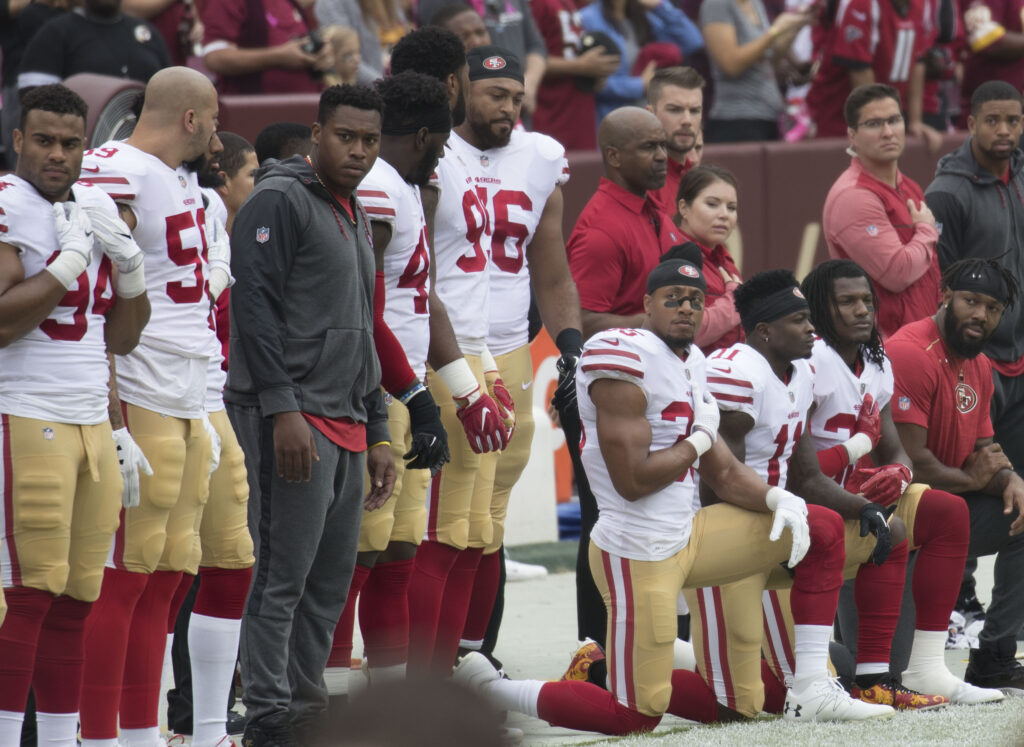
Here we go again. Prepare for another round of NFL players taking a knee, Donald Trump giving them the finger, owners grimacing in their suites, and commissioner Roger Goodell serving as a punching bag.
Suddenly, the 2020 season is poised to resemble the 2016 season, when Colin Kaepernick and his “Perilous Fight” landed on the cover of Time magazine and Trump later hammered the league, offering advice to owners when players kneel during the national anthem: “Say ‘get that son of a bitch off the field right now. Out. He’s fired.”
Kaepernick and other players were peacefully protesting police brutality, but critics said it disrespected the flag and the country. The national anthem became a national obsession. Before then, it was such a big deal that networks neglected to air it; they ran commercials instead, making a point of making a profit.
“You have to stand proudly for the national anthem, or you shouldn’t be playing, you shouldn’t be there. Maybe you shouldn’t be in the country.” — Donald Trump
“I love America more than any other country in the world and, exactly for that reason, I insist on the right to criticize her perpetually.” — James Baldwin
Some of my fellow Americans have it twisted. They think pointing out the nation’s ills and demanding better is akin to hating America. They rudely invite dissenters to depart if the good ol’ U.S. of A. isn’t good enough.
It’s an age-old attitude that resurged during the Vietnam War era and was emphasized in a 1970 song by country singer Ernest Tubb.
The international agents who collect paychecks for stoking tensions along America’s color line should be worried. The boss could soon deem them superfluous, leading to reduced salaries, furloughs or outright pink slips.
That would be my thinking from afar while contemplating events in the United States: Why am I paying comrades to stir discord when folks like Derek Chauvin, the McMichaels, and three Louisville officers are doing such exemplary work?
Chauvin, the former Minneapolis cop who killed George Floyd on a Monday, was arrested by that Friday, leading the state‘s Department of Public Safety commissioner to note, “this is by far the fastest that we’ve ever charged a police officer.” Earlier that week, the Associated Press said Chauvin had been targeted with false claims on social media that tied him to “political agendas and racist ideologies.”
 Follow