I didn’t know that “releasing”
is a whole situation. I recently decided to do it with my dissertation, sending
it to an editor.
That was an important milestone and I was excited to get there. Much like the anticipation a mother feels as she nears delivery, I was ready for the next step.
However, I also felt something
else.
I want to say it was trepidation because everything is becoming much more real. I also felt a bit exposed because now my story – my dissertation – was out there. Someone who has never seen or read it was looking at it with fresh eyes.
It’s like when you’re carrying a child in your womb. Inherently, you understand that your bundle of joy will pop out at some point. You know you’re supposed to be this amazing mother when it happens. But you worry about being exposed as someone who actually doesn’t know what she’s doing.
So here I am releasing my dissertation, “my baby.” (My husband and I agreed to not use that term in the beginning; we call it my “project.“) Here I am sending it to a complete stranger to edit and provide feedback. It sounds dramatic. But when you’ve lived with something so long, letting go can be uncomfortable.
It’s necessary though.
Releasing is progress and growth and movement. Those are good things. As mentioned previously in this space, it’s all part of the journey. I’m just beginning to share my project with the world, which – scarily – feels good.
Just like in childbirth, joy and fear are all in there, mixed together. They create an amazing feeling that swings between extremes at any given moment, for the rest of your life.
So go ahead and release, like
I’m doing. Slowly but surely, I’m stepping out with this project. Soon I will
experience the joy and fear that accompanies birth.
I say whatever you’re working
on, don’t be afraid to cut the cord when it’s time. Intuitively, you’ll know when
that time arrives. It’s the gift you’ve been waiting for.
Truly, releasing is only the
beginning.
(A former journalist currently
working on her doctorate in Social Emotional Learning, Vanessa is a dedicated
and passionate educator in the DC Public Schools system. She loves learning,
leadership, innovation, collaboration, and discovering new ways to drive
student gains and support staff members).
Let’s be honest. Anyone who is trying to accomplish something big must have an ego on some level. And that especially includes those of us pursuing doctorate degrees.
I struggle with this at times when contemplating my purpose in pursuing this goal. I don’t consider myself an egomaniac and I don’t believe many people perceive me that way, either (except maybe my daughters).
However, the same ego that’s necessary to pursue a doctorate is the same one that’s repeatedly bruised and beaten.
Therein lies the paradox. It takes an ego to pursue big
dreams and major life goals, but it also takes a willingness to release your self-pride
so you can endure the process and reach the destination.
Consider what you’re pursuing and what part of your ego needs to be released in order to get there. Learning something new or doing something for the first time takes self-belief. But this “ego” has to be broken enough to accept help while exercising patience, discipline, perseverance, tenacity, grit, and faith.
How much ego is too much? Who’s to say?
Too much will cause you to overstate and overdo. Example: I will complete (insert your goal here) by 5 p.m. on the first of next month. Too little will get you nowhere. Example: I will never complete
(insert your goal here) because (insert negative, self-doubting words here),
See the enigma?
So, I conclude most of us have an ego. And that’s not a bad thing if you accept that sometimes it’s hurt or broken. If it’s strong enough, you’ll get back up and keep trying after you’re knocked down.
Let’s face it: You won’t accomplish much in life without some
ego.
But too much will mess you up.
###
(A former journalist currently working on her doctorate in
Social Emotional Learning, Vanessa is a dedicated and passionate educator in the
DC Public Schools system. She loves learning, leadership, innovation,
collaboration, and discovering new ways to drive student gains and support
staff members).
Have you ever searched for the
Easy Button? I need to find it – or a Lifeline – right about now. There must be
a secret escape exit somewhere.
Some days on the doctoral journey,
you just wish there was a safe word you could use to catapult yourself to
completion.
Surprise, surprise. There are no shortcuts
– and we knew that.
When my mind trails off after
several hours on seemingly the same paragraph, I long for a quick fix. That Easy Button must be here somewhere.
Then reality eventually hits, and I
realize there’s no “workaround” because I’ll just work myself right around to
where I started. Or stopped.
But I wouldn’t have it any other
way. I’m learning and growing and becoming an expert in a particular area of
study. So, no, there’s no finagling. I don’t get to skip the hard parts on this
journey – or any other journey for that matter – if I want to actually accomplish
the thing I’m trying to accomplish.
Doing hard things requires doing
hard things. So, whatever your thing is, just go ahead and do the thing: losing
weight, quitting smoking, finishing school, cleaning your house, writing a book
… whatever. Heed the Nike slogan.
There’s no use searching for the
Easy Button. It doesn’t exist.
I know because I looked.
(A former journalist currently
working on her doctorate in Social Emotional Learning, Vanessa is a dedicated
and passionate educator in the DC Public Schools system. She loves learning,
leadership, innovation, collaboration, and discovering new ways to drive student
gains and support staff members).
There’s an untidiness to this doctoral journey that I had not anticipated. Even though I was told early on that the path to Dr. Snyder isn’t direct, I didn’t fully grasp the concept until now.
I was told it’s an “iterative”
process, which basically means circling back and forth in different directions.
In terms of writing this dissertation, it means cutting, replacing, undoing,
rewriting, deleting, pasting, rearranging … you get the picture.
It’s messy.
Yes, there’s a rubric. And you’d think
that an educator of more than 20 years could just follow the roadmap and reach
my destination, right? However, just because there’s a rubric doesn’t mean the
path is straight or clear.
Right now, I must have at least 15
versions of my dissertation. It’s too early to delete anything. I’ve often had
to resurrect an earlier version with information I didn’t think I would need, only
to discover that a crucial paragraph written 12 months ago is necessary to move
forward.
It’s messy.
But in the end, I will produce a
clear, well-researched, and well-written body of scholarly work, a study that I
believe will ultimately change lives.
Consider your successes and your
accomplishments. Remember the journey along the way.
Was it seamless? Did you ever
start over? Were there detours and
missteps? Did you have turn around to get something/someone you thought you
didn’t need? I know I did.
And right now, it’s all still a
little messy.
So, I will embrace this messiness.
Because like so many other things in life, messiness is part of the process.
But it’s so worth the reward in
the end.
(A former journalist currently working on her
doctorate in Social Emotional Learning, Vanessa is a dedicated and passionate
educator in the DC Public Schools system. She loves learning, leadership,
innovation, collaboration, and discovering new ways to drive student gains and
support staff members).
I really wanted the name of this blog to be “Milestones.” It
would’ve been so perfect, having started at end of an unusual year and with the promise of
a new one. Writing about reaching the next milestone in my doctoral journey would’ve
been a lot more fun, and perhaps even easier to write.
Well, I’m not there just yet.
Nonetheless, here I am on a Sunday morning of gentle snow –
24 hours after spending yet another Saturday filled mostly with writing – reflecting
on what has become a personal holding pattern.
Holding patterns aren’t very exciting on the surface, but further
examination reveals some progress. For example, I’ve completed the first three
chapters of my dissertation without being told to start all over (which was a
real fear)!
Right now, I’m stepping back to take a critical look at what
I’ve written and ask myself important
questions.
Am I telling the story I need to tell? Have I captured the full scope of my research
problem? Is it clear? What’s missing? Do I need to do more?
How does my dissertation compare to others? (I spend lots of
time reading successful dissertations.)
Turns out you can be pretty busy during “holding patterns.”
They don’t indicate lack of activity. They actually mean the
opposite if you embrace it. They’re opportunities to learn, think, and reflect
before moving on to the next thing. They force you to be in the moment and
absorb all that comes with it.
It’s almost like doing a plank. Your whole body is holding
and it hurts. But something is happening inside of you that makes you stronger
if you stay in the position. Holding patterns are necessary and we can’t skip
them, because that’s often where we learn.
So, don’t run from holding patterns in your life. Embrace
them. Learn from then. Build upon them.
Before you know it, you’ll be at the next thing – probably
the milestone you’re waiting for.
(A former journalist currently working on her doctorate in
Social Emotional Learning, Vanessa is a dedicated and passionate educator in
the DC Public Schools system. She loves learning, leadership, innovation,
collaboration, and discovering new ways to drive student gains and support
staff members).
I’ve created my own definition
for the word “dissertating.”
It’s actually in the
dictionary as a form of “dissertate,” a verb. Not surprisingly, it is the act
of writing a dissertation. Silly me thought I was making up the word. I mean,
why is it a verb when all everyone talks about is the dissertation (a noun)?
Here’s my definition of
dissertating: “The act of writing, researching, thinking, hoping, praying,
believing, dreaming, and working toward a doctoral degree.”
It’s probably a bit
blasphemous for a former English teacher to make up her own definition, but
forgive me. Dissertating is causing me to think in all kinds of unusual ways. And
because we’re at year’s end, I’m reflecting.
So, I believe dissertating –
as a concept – is a thing. You probably understand if you’re working on a
dissertation or another major goal.
At any given moment, I’m
dissertating. If I’m not thinking about it, I’m actually doing it. When I’m not
doing it, I’m planning when I’m going to do it. If I’m not planning it, I’m for
sure praying and believing and hoping for it.
It’s a cycle, all day and every
day to varying degrees. Dissertating never quite stops. Even in this moment, awaiting
feedback from my committee chair, I’m thinking and wondering.
Could the draft I submitted
been better? Did I miss something? Did I read the rubric closely? Will my chair
find something new? Will the second chair agree?
However, as 2020 comes to a
close, I’ve come to a realization. If dissertating is a verb that permeate my
life so thoroughly, perhaps there are other nouns in my life that should become
verbs.
Nouns like peace, joy, and humility
come to mind.
If I can work this hard at “dissertating,” then I can work equally hard at “peacing” everywhere, “joying” in all things, and “humiliting” through life. Those actions join two common nouns/verbs – love and belief – that deserve as much effort as I expend dissertating. I can work equally hard at loving others and just as hard at believing in myself and, most importantly, God.
Once again, I am reminded that
this doctoral journey is about so much more than a few more letters behind my
name. It’s about growing and becoming who I’m meant to be. I hope that you’re encouraged
to create more verbs in your life as 2020 ends.
Happy New Year!
(A former journalist
currently working on her doctorate in Social Emotional Learning, Vanessa is a
dedicated and passionate educator in the DC Public Schools system. She loves
learning, leadership, innovation, collaboration, and discovering new ways to drive
student gains and support staff members).
I’m wondering if
feedback is just another word for criticism.
It’s not. Dictionary.com
defines feedback as a “reaction or response to a particular process or
activity.” (I already knew that but needed confirmation).
The sting of feedback is real, especially when you’re on the doctoral journey. Sometimes you just don’t want to hear it. And don’t get me started on disagreeing with the feedback and trying to challenge it.
Today my chair finally sent some feedback I was waiting on and oh-so-anxious to receive. Now I can move forward in my doctoral process. As I’ve said before, opening emails from your chair is a scary act, but there’s no way around it.
Sitting here after absorbing
the feedback, I’m feeling some kind of way. I’m glad it came because now I know
what to work on. But it doesn’t feel that good. As an educator who consistently
delivers feedback to teachers, the shoe is now on my foot.
And guess what? It’s
not much fun. I don’t necessarily feel as professional and mature as I expect
my teachers to be when they’re on the receiving end.
In this case, much of the
feedback I’ve received over the past few years relates to scholarly writing. Though
I consider myself a good writer (at least before beginning this project) writing
in a scholarly fashion doesn’t come naturally.
The point I’m trying to
make is this: Feedback is about growth and about mastery. It’s important to
keep that front and center.
Still, it’s hard to accept
that I’m not a whiz at scholarly writing. However, that’s the truth. I have to
take my medicine (i.e., feedback) and get better so I can finish this journey.
The broader lesson is something all of us can learn from. In what areas have you had to accept feedback in order to improve? We can’t grow without taking constructive assessments and applying them to areas of life. School, work, relationships … all of these elements can be better with proper feedback.
Our challenge is to
take it, incorporate it, and advance.
You can guess what I’ll
be doing this weekend.
(A former journalist
currently working on her doctorate in Social Emotional Learning, Vanessa is a
dedicated and passionate educator in the DC Public Schools system. She loves learning,
leadership, innovation, collaboration, and discovering new ways to drive
student gains and support staff members).
In the spirit of the holiday, I just want to focus on appreciation and gratitude. Doctoral reflections can wait!
Here’s my “thankful” list, in no particular order:
I will gather with family again – even though this
time it’s just the ones I live with – for another Thanksgiving.
I have everything I need.
COVID has given me the gift of additional time
to write and research.
I’m getting closer to completing my doctorate.
I recognize my process is unique to me and it’s
okay.
My husband is supportive.
I’m more patient now.
I believe in my subject matter (Social Emotional
Learning and leadership).
I have the strength and will to keep working.
My daughters are supportive (most days).
I’m not discouraged (this week).
Through my reading, writing, and research, I’m
learning and growing.
I have a great family.
I have faith in God to sustain me through this
journey and everything to come.
I hope and pray that you appreciate your many reasons to be thankful, too, despite anything else. Happy Thanksgiving!
(A former journalist
currently working on her doctorate in Social Emotional Learning, Vanessa is a
dedicated and passionate educator in the DC Public Schools system. She loves
learning, leadership, innovation, collaboration, and discovering new ways to
drive student gains and support staff members).
They’ve taken on a whole new meaning as I work through this
huge writing project. I’m calling it a huge writing project because, ultimately,
that’s what it is.
(Speaking of writing, I thought I was pretty good before
this process; but I digress. That’s a different blog.)
Here’s what happens on Saturdays. I “sleep in” until 7 or 8 a.m. Yes, that’s sleeping in for me now that I’m older. Then I write until 10 a.m. before breaking for breakfast with Deron and our regular call to my mother-in-law.
I resume writing between 11:30 a.m. and noon and keep at it
until about 4 or 5 p.m. (with small breaks). That happens every Saturday
without fail.
I actually look forward to it because that’s the day when I
can get a great deal of work done without interruption.
So, what I have discovered about myself as each Saturday is
spent writing all day?
I’m more disciplined than I thought. I have started and
stopped so many things in my life that I never consider myself a person of discipline. However,
I’ve been tackling this dissertation for about three years now, steadily
working, especially on Saturdays.
So, the lesson is I’m disciplined when I decide it’s worth
my time.
How about you?
What things do you manage to do, no matter what? What about
those things you want to do – or so you say – but haven’t quite started yet?
Even as I sit here writing this blog, I recognize the commitment
to be disciplined in this moment. It’s exciting to know I can stick with
something and reach a long-wanted to goal.
Right now, it’s still difficult to imagine being done with
this journey. But if I remain disciplined, I believe I’ll ultimately get there.
And I bet you, too, have more discipline than you imagine.
(A former journalist currently working on her
doctorate in Social Emotional Learning, Vanessa is a dedicated and passionate educator
in the DC Public Schools system. She loves learning, leadership, innovation, collaboration,
and discovering new ways to drive student gains and support staff members.)
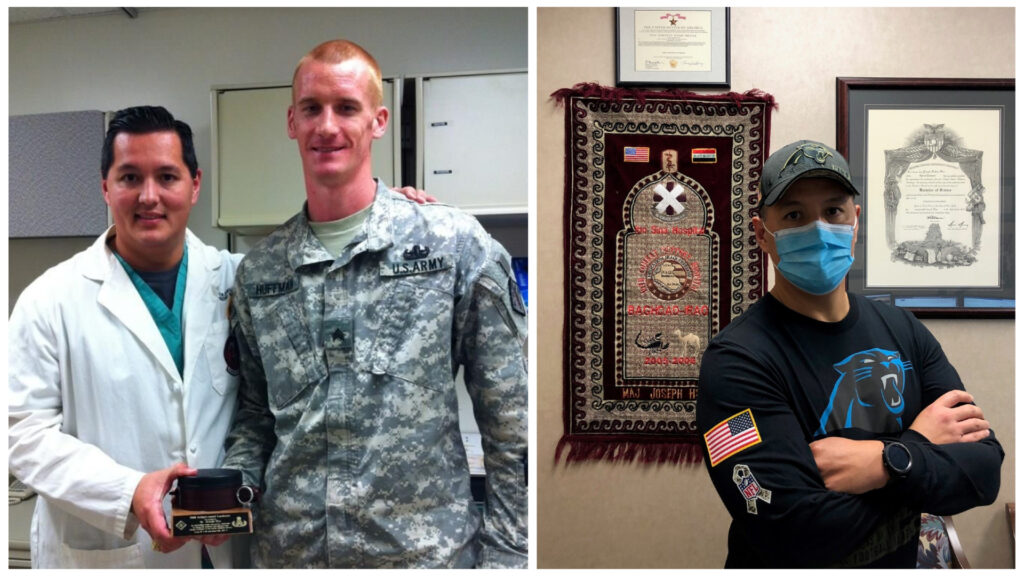
Joseph Hsu, MD, has a keen understanding of our veterans’ contributions to society. He graduated from the United States Military Academy at West Point. He then went on to serve in Iraq during some of American troops’ fiercest encounters with enemy forces. He has used his training and skill to help numerous veterans recover from their injuries. Through his dedicated years of service, he was even awarded the Bronze Star Medal – the fourth highest ranking award a service member can receive for a heroic and meritorious deed performed in conflict.
Dr. Hsu also sees a connection that perhaps many may overlook: the medical advances that civilians can enjoy as a result of veterans’ sacrifices. He thinks about it often, especially during the “NFL Salute to Service” campaign, which the Carolina Panthers will celebrate on Nov. 15 when they honor him and host the Tampa Bay Buccaneers.
“We are proud of our longstanding partnership with the Carolina Panthers and honored to celebrate and recognize members of the military as part of the NFL’s Salute to Service. Atrium Health is committed to extending appreciation to those who have previously served and those who are currently serving our country,” says Claude T. Moorman III, MD, president at Atrium Health Musculoskeletal Institute.
“I couldn’t be more honored to be part of ‘Salute to Service,’” says Dr. Hsu, an orthopedic surgeon who serves as vice chair of quality at Atrium Health Musculoskeletal Institute and director of the limb lengthening and deformity program. “The Panthers have been very involved in veterans’ affairs and I’ve been fortunate to be part of that.
“The team has been instrumental in raising money and supporting the Veterans Bridge Home,” he says. “This is a pro sports team that’s really dedicated to vets’ issues. The Panthers put their money where their mouth is.”
 Follow