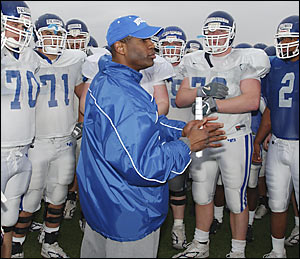
Have you noticed that NFL linemen tend to be very large, while NBA centers are invariably very tall? And marathon runners are usually slender, while jockeys stand short? The only shock about those observations would be if someone failed to notice. You can’t watch football or basketball without picking up on the participants’ physical profiles. There’s nothing subtle about 7-footers or 380-pounders, and we’re totally comfortable pointing out their size because there’s a direct correlation to their job requirements.
However, discussions become much thornier when we highlight a distinction that has nothing to do with the task at hand and yet stands out just as much or more: skin color. Some of the most glaring examples — say, the scarcity of African Americans in the NHL and Major League Baseball — can be explained as purely cultural coincidences. Black youths simply don’t play that much hockey or baseball; consequently, not many grow up to be pros in those sports.
But if we highlight the scarcity of white halfbacks, wide receivers and defensive backs in the NFL (or white players in the NBA, period), the discussion gets more complicated. Tens of thousands of white kids play football and basketball, from youth leagues to high school and through college. So our conversation takes an awkward turn, with stereotypes and preconceptions battling reason and logic for supremacy. As the late tennis great Arthur Ashe said in the 1989 NBC News special Black Athletes — Fact and Fiction, the issue of race in sports is “a sociological red button.”
I didn’t realize the good fortune in being assigned to Carver Hall upon my arrival at Howard University in 1982. It was one of two all-male dormitories (the other was for lowly freshmen; I was a transfer), and I soon discovered that it was the only dorm with a 24-hour visitation policy. We enjoyed the privilege of having company anytime we wanted, even overnight.
At some point in time those privileges must have been rescinded, because Howard was in the news last week for once again allowing upperclassmen in one residence hall 24-hour visitation. Residents at every other dorm must continue to escort their guests out by midnight during the week, or 2 a.m. on Friday and Saturday nights. But a 2 a.m. curfew must seem like unbridled freedom to members of the University of Kansas football team, who are saddled with archaic restrictions under first-year coach Turner Gill.
One of five black coaches at college football’s highest level — the Bowl Championship Series leagues — Gill has instituted at least two rules that will test his young players’ discipline, if not break their will. The first isn’t too bad: Players must hand over their cell phones the day before a game and go without until the game is over. But the second is downright puritanical, an edict that challenges common sense as much as common decency.
The Twin Tower attacks, assorted suicide bombers and global furor/death threats sparked by creative works have pretty sealed the perception of Islam for many Americans. Although the vast majority of Muslims denounce the terrorism and insist that Islam advocates peace and harmony between all people, a sizeable segment of our society believes that Muslims are out to kill non-believers and take over the country, if not the world.
I’ll be the first to admit that Muslims at the radical end of the spectrum are VERY EXTREME. But I have a frat brother who’s a Muslim, an award-winning journalist with a national cable network, and he’s as extreme as coffee with milk. So are millions of others. I guess that’s a common of description of many folks who eventually flip out and shoot up their office, but I think that’s more of a mental health issue than adherence to religious doctrine.
Because the truth is, you can cause mayhem and destruction in the name of any religion. It just depends on how you interpret and pervert the scriptures.
New York Times columnist Nicholas D. Kristof illustrates the point perfectly in a pop quiz.
As the mother of two girls, it’s difficult to resist a book titled “Five Conversations You Must Have with Your Daughter.” But I haven’t finished Vicki Courtney’s book yet, because it’s something you’re never really done with. I find myself stuck in the chapter that focuses on beauty and self-image. It encourages parents to teach their daughters to shun society’s view of beauty.
That’s easier said than done, particularly for African-American girls. Our beauty is rarely the standard gracing magazine covers. We’ve made strides, but our beauty isn’t the status quo. My dear friend Darla Davenport-Powell – a mother, author and producer – has worked hard to broaden society’s definition of beauty for nearly 20 years. She created the “Niya” doll in 1991, named after her lovely daughter. “All children deserve to see themselves reflected in a positive light,” Darla says. “All children are brilliant and beautiful. I wanted to make sure that our children had the proper images that would affirm their greatness.”
September was crazy this year, but in a good way. We moved into a house and then celebrated our 20th wedding anniversary, leaving the boxes and clutter behind for four fantabulous nights in beautiful Cancun. If you’re looking for recommendations for a getaway of your own, I have three words for you: Excellence Playa Mujures.
I’m sure there are other all-inclusive, adults-only resorts that would’ve earned the same review. But since this was our first experience at such a place, we can’t compare it to anything else. However, it’s hard to imagine having a better time in a better setting with better accommodations and better service than we enjoyed last week.
When you’re the parent of two active children, often in their company and the presence others like them, it can take a moment to grow accustomed to seeing nothing but grown folk morning, noon and night. But once you get used to it … I wouldn’t trade my girls for anything, but I’d be lying if I said I missed them! I figured I’d see them and their friends soon enough, so I definitely enjoyed the break!
There. I said it. I’m an educator and a parent, and I’m sorry to inform you that standardized testing isn’t the magic bullet to solve our problems in education. Even colleges are trying to put the tests in perspective.
The exams are just a way to cast blame, and in this case, all fingers point to the teachers.
Yes, we need standards. Yes, we need to assess our children so we know whether they’re learning. Yes, teachers should be held accountable. But teaching children isn’t that simple. It’s not just about trying to fix the teachers so the students can learn.
I’m getting real tired of the mentality that kids aren’t learning because teachers aren’t teaching or don’t know how provide proper instruction. All of our lives would be easier if teaching was that simple.
I understand our society’s need for easy solutions. But if you’ve never taught – trust me – you have no idea of the challenges we face in the classroom. Especially in many urban schools. And many of the challenges are beyond our control, such as home environment, learning disabilities, emotional well-being, physical health, parental involvement, school resources, curriculum decisions, etc. Nevertheless, all of those obstacles impact a student’s willingness and, yes, ability to learn.
Let me stop the chorus before it starts another verse of “You don’t believe every child can learn!” That’s not true. I DO believe every child can learn. But learning occurs in different ways at different paces for different children. There’s no cookie-cutter system that will guarantee all our children suddenly reach high levels of achievement.
If we would let good teachers teach, committing to support them and address those issues beyond their control, we would see achievement levels begin to rise. It would still require hard work, but we’d be headed in the right direction.
However, if we continue to hide behind standardized testing, as if it tells the entire story, then things won’t get any better for anyone.
Remember Trinity United Church of Christ, President Obama’s former place of worship? I don’t know what’s been going on over there the past few years, since Rev. Otis Moss III succeeded Rev. Jeremiah Wright as pastor.
But I absolutely LOVE what their Married Couples Ministry did at church a couple of Sundays ago.
I dare you to watch the full video, to study these couples with four to 40 years of holy matrimony and not feel warm and fuzzy inside. Rarely do we witness such beautiful expressions of Black love, and they’re virtually nonexistent between Black husbands and wives.
It doesn’t matter that some are better dancers than others. It doesn’t matter that some look much more comfortable in moving to Babyface’s secular love song. And it doesn’t matter that some churches are absolutely, positively guaranteed to frown upon a display like this, period, let alone inside the sanctuary.
I don’t care. The only thing that matters is the loving glances and gentle touches these spouses exchanged. The only thing that matters is the intimacy they intensified, the emotions they engendered and the flames they fanned. Growing closer to your spouse certainly takes more than dancing, kissing and making love.
But life together is a whole lot sweeter with those elements in plentiful supply!
We haven’t settled on a church home yet since returning to D.C. last summer. However, I know one thing for sure – I’d like to participate in something like this at our future church. In fact, if every marriage ministry did something similar to this, I believe it would enhance the state of our unions.
There’s no turning back now. My novel has its ISBN number and is being typeset as I type this. The cover is done, pre-order sales are coming in and I’m talking about The Second First Ladymore and more, because it’s real and coming to life.
One moment I’m excited. The next moment I’m petrified. What people will think of me and say about the book? Is it good enough? Will anyone besides my family and friends buy it? Will they read and enjoy the story? I certainly pray so.
That’s the weird thing about writers who struggle to finally produce a project they’ve carried around for a long time. We say we want it, but fear creeps in when it finally happens. I guess it’s because writing is so personal. And once you’re published, you’ve opened yourself to those who will criticize your work. Whether or not the critiques are valid, they can still sting.
But I say it’s still worth it. Your story comes from somewhere deep inside and it matters to you, and potentially hundreds or thousands of readers out there. Learning to accept and grow from the criticism is part of the writing process. Even before the book is bound, I already know many things I could’ve done better. I’ve learned to care more deeply about crafting a story. Most writers might know how to create a good story, but it takes time and research to carefully craft one.
That’s why going to writing conferences and meeting other writers is so important. In the coming weeks I’ll blog about other Christian authors and seek their insights on getting started in Christian publishing.
My co-publisher Barry Beckham, of The Beckham Publications Group, has worked with newbies like myself for decades. He can help you avoid mistakes that first-timers often make and he always has sound advice in his newsletter, Better English 101 Writing.
So take the bitter pills of criticism and write an even better book next time. Like I tell my students, writing is a process.
This is what I wrote on news-press.com on Feb. 14, 2008:
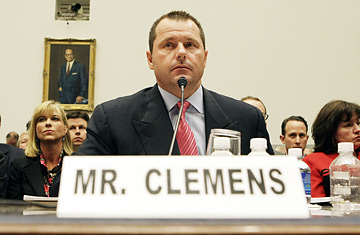
“I’ve always suspected Roger Clemens was among the hordes of major-leaguers who used performance-enhancing substances during baseball’s Steroid Era. Nothing that has transpired since the Mitchell Report was released – including Wednesday’s circus on Capitol Hill – has changed my opinion. I believe Clemens stood before the House Committee on Oversight and Government Reform and told bald-faced lies. Through his teeth. Clemens pointed fingers at his wife, his mother, his agent and his close friend Andy Pettite, who testified that Clemens admitted using HGH. Clemens is banking on folks’ incredulity that someone could lie under oath at a Congressional hearing on national TV. If you don’t believe that someone – Clemens, in this case – could do that, you’re a sucker.”
Fast-forward: I don’t know if “The Rocket” will be convicted of perjury for the lies he told Congress. A law professor’s article in Sports Illustrated details a possible defense that sounds plausible, at least enough to keep Clemens out of jail. Considering the high-powered, top-dollar attorneys he’s likely to retain, Clemens (and fellow would-be Hall of Famer Barry Bonds) could very well overcome the feds’ 90% conviction rate.
In any case, Clemens has decided to go down swinging if necessary, sticking to his arrogant denial until the bitter end. “I never took HGH or Steroids. And I did not lie to Congress,” he said on Twitter Thursday night, after being slapped with a 19-page indictment. “I look forward to challenging the government’s accusations, and hope people will keep an open mind until trial.”
He’ll have to look elsewhere. As far as I’m concerned, there’s already a preponderance of evidence that he can’t overcome. Not only do prosecutors have his deposition AND his performance on Capitol Hill (the latter totally voluntary on his part), they also have another fine example of his hubris, the “60 Minutes” appearance.
None of this is to suggest that Congress had good reason for either of its dog-and-pony steroids hearings. In the first one we saw Sammy Sosa forget that he speaks English, Mark McGwire refuse to discuss the past and Rafael Palmeiro point his finger while lying. In the second one, we saw Clemens and former trainer Brian McNamee call each other liars while Republicans hammered the small fry and Democrats grilled the superstar. The 4-1/2 hour spectacle was less informative than an episode of “Jerry Springer.”
But whether we’re talking about potential Hall-of-Famers and perennial All-Stars, or middling utility players and a mediocre journeyman, the fact remains the same: There was a lot of cheating going on. And from baseball’s point-of-view (the feds gotta do what the feds gotta do), it doesn’t make much sense to single out guys. At this point, we shouldn’t be shocked at any name that’s eventually linked to steroids.
We will never know every player who indulged, so it doesn’t make sense to keep some out of the Hall of Fame while letting others in. And we certainly can’t tinker with the record book, trying to determine who did what, when they did it, and how it affects statistics. (Does it count if a juiced batter hit a home run off a juiced pitcher)?
Clemens has issues to face in court, but that’s a personal problem. But baseball is better off letting fans apply their own mental asterisk to the entire era, and then turn the page.
A new school year is upon us. New clothes, bookbags and an endless list of supplies. If you’re a parent, you know the scene well.
I remember the excitement I always felt as a child on the first day of school. The new year always began with such promise and energy.
I think parents and educators (such as myself) feel it, too. There’s something exhilarating about a new classroom, new set of students and new opportunity to do better than the year before.
But as I prepare myself and my daughters for the upcoming school year, I’m thinking about their teachers, and the challenges we face in this profession. This is a good time to be thankful for teachers and all that they do to educate students.
Contrary to what you may read, some teachers are actually teaching – and doing it correctly at that. Maybe, at least for a moment, we should stop blaming them for everything that’s wrong with students. We should know it’s just not that simple.
The start of the new year is a good time to be grateful for all the moneyand extra time that teachers spend in trying to teach our children. So many teachers give everything they’ve got and more to educate students (trust me, because I have the receipts to prove it).
But it’s not just about the money and time that spent. There’s a teacher I’ll never forget from my senior year. Her name is Mrs. Kovach and she taught a medical assistance class. I don’t know why I was in the class, as I never had any remote interest in medicine. But I remember how much she seemed to care and want the best for us. I still recall our last day with her, when she challenged the class to go out in the world and “live our dreams.”
For some reason, those words have resonated with me over the years. Maybe because it made me feel like she cared and wanted the best for me. I think many of us have those special teachers who impacted our lives along the way. If you do, I invite you to share your memories in the comments section below.
 Follow