Paula Flowe doesn’t know exactly how many people will show up Friday afternoon for a rally at the Texas State Capitol. And she doesn’t know exactly how many people will join her in sleeping out there until proposed legislation in Congress (H.R. 5628) becomes law. But Flowe is certain that her cause — banning corporal punishment in schools — is worth the time and effort, even as she’s run through her retirement money and is in danger of losing her house.
“We have people coming in from Alabama, Arkansas, Tennessee and remote parts of Texas,” said Flowe, founder and executive director of The Hitting Stops Here! “We have one woman whose son was brutally beaten by a 400-pound teacher. The school said there’s nothing wrong with the child, but it will pay for his counseling. If nothing’s wrong, why pay for counseling? If Sasha and Malia went home like that, there would be an outrage.
When I took a buyout from Gannett in July 2009 – after nearly a quarter-century as a fulltime journalist with the company – I also decided to cut off my shoulder-length dreadlocks that took eight years to grow. In the midst of so much transition (returning to D.C.; no job; potential career change; maybe grad school), going with a different look just felt right. Shaving my head signified that everything was brand-new at that point, personal appearance included.
But I’d be lying if I said mainstream attitudes toward dreadlocks didn’t play a role in my decision. No longer an established professional at the top of my field, I could envision prospective employers holding my hair against me – consciously or not. As much as I loved my dreads, I wasn’t willing to risk them being a hindrance to new opportunities.
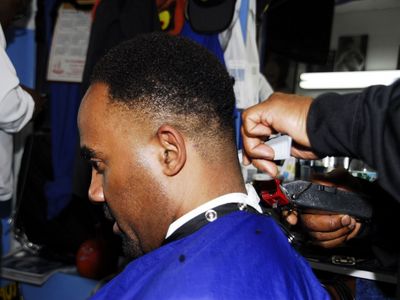
Such decisions are much less stressful for brothers compared to sisters. I didn’t last long as a baldie (WAY too much maintenance for someone used to once-a-month appointments), but my low-cut natural never draws second looks, unlike the effect when a sister wears one.
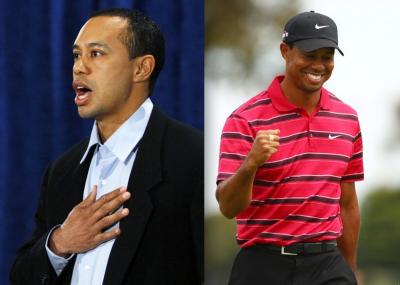
We can only imagine what Thanksgiving was like last year in the Tiger Woods household, which since then has shrunk from a family of four to a bachelor pad. A National Enquirer story on Woods and New York cocktail hostess Rachel Uchitel had hit newsstands the day before, but it hadn’t garnered any attention.
And it might have remained just another juicy rumor from the National Enquirer if Woods hadn’t crashed his Cadillac Escalade into a tree beyond his driveway at 2:25 a.m. on the morning just after Thanksgiving. His wife, Elin, bashing out the SUV’s back windows with a golf club didn’t help matters, either.
That incident was the beginning of the end for Woods’ carefully crafted, squeaky-clean image. In its aftermath, he suffered a severe outbreak of alleged mistresses, entered therapy for sex addiction, lost several major sponsors, watched his wife file for divorce and endured his worst year on the golf course.
Just like that, Thanksgiving and Woods were inextricably linked in people’s minds, likely forever.
Did you see the video of a high school basketball coach whipping a player that went viral recently and spawned a mass of outraged viewers? Murrah High School’s Marlon Dorsey admitted to “paddling” his students — even though corporal punishment has been banned in Mississippi’s Jackson Public Schools since 1991 — stating in a letter that he “took it upon [himself] to save these young men.”
Placed on leave with pay, Dorsey has swept corporal punishment back into the news, right after Joe and Katherine Jackson reignited the debate in an interview with Oprah Winfrey. The incident in Mississippi reminds us that some states actually allow corporal punishment in schools, and it’s difficult to determine the bigger shock in that regard. Is it that 20 states still believe it’s OK for school faculty members to spank students? Or is it that some states don’t require parental consent or notification for children to be physically punished at school?
If you think those two things are bad, there’s actually a third choice for what’s worse: Some states have “teacher immunity laws” to protect employees from criminal or civil action. The list includes a who’s who of the Confederacy: Alabama, Georgia, Mississippi, North Carolina and Texas. Dorsey, however, picked the wrong school district to work in. Unlike Jackson, most of Mississippi’s 152 school districts allow corporal punishment, and would have offered him a measure of protection against a lawsuit that three of his players filed against him Nov. 9.
Join Washington reporter Cord Jefferson as he talks with contributors Deron Snyder and Bassey Ipki about Kanye West’s mental health and whether same-sex education for black boys will help close the achievement gap.
Here are the latest depressing reports on the plight of African Americans: Only 12 percent of our fourth-grade boys are proficient readers, compared to 38 percent of white fourth-grade boys. By eighth grade, reading proficiency falls to just 9 percent for black males, 33 percent for whites.
Clearly, this is a crisis situation, with black males almost twice as likely as white males to drop out of high school, and a dropout rate of about 50 percent in some big cities. Black males comprise about 5 percent of college enrollment nationally but about 30 percent of the prison population. Based on this depressing achievement gap, the demand for prison beds could remain strong for the foreseeable future.
Or we could open our minds to a different, controversial approach, such as the route taken by Urban Prep Academy, an all-boys charter school in Chicago. While there are pros and cons for same-sex education, we should consider the success of Urban Prep and try to replicate it on a wide scale. Any school that places 107 out of 107 seniors into college is worthy of emulation. Considering the fact that those seniors hail from some of Chicago’s most disadvantaged, impoverished and crime-ridden neighborhoods, Urban Preps should be popping up across the nation as we speak.
Like many establishments of its kind, Lee’s Barbershop offers customers more than a cut and a shave. They can get news on the NFL, happenings in the community, advice on women, rumors about the mayor and updates on local artists. And like a growing number of black barbershops, Lee’s participates in potentially, life-saving health initiatives for its customers.
“The shop is definitely used as an outreach station to make the black community aware of services that will save their life,” says Arthur Lee, who has owned the establishment in Washington, D.C., for nearly 25 years. “Non-profits do things like high-blood pressure screening and HIV testing in front of the shop. We’ve been part of a condom program since about 2005. People who don’t even get their hair cut will come by and get (condoms)…because they’re free.”
Dr. Bill Releford knows that many black men frequent the barbershop way more than a doctor’s office. So he founded the Black Barbershop Health Outreach Program in 2007, starting with his own barber in his own Los Angeles community. Now the program has gone national through a 50-city tour, and more than 25,000 men have been screened for diabetes and high blood pressure in more than 400 barbershops. Releford said his goal is to screen 500,000 men by 2012.
My grandmother “Nana” was the dearest, sweetest, kindest and most loving woman I’ve ever known, a woman who raised her six children alone after being widowed at an early age. A fierce prayer warrior and strong woman of God, she was a Sunday-school superintendent and later a church mother.
And whenever she felt it necessary, Nana was deft with a strap across legs and hind parts. Following in her footsteps, my mother worked a mean slipper.
But they never went crazy or got out of hand, not like Joe Jackson and other parents accused of atrocities such as oiling their children before beating them with an ironing cord. No, with Ma and Nana, it was always just two or three licks and they were done.
Yours truly was a guest Wednesday on NPR’s “Tell Me More with Michele Martin.” The topic was my “Menthol Madness” article on The Root, regarding the FDA’s proposed ban on mentholated cigarettes.
The proposal has caused a rift among forces that advocate on behalf of blacks’ interests, including the NAACP, Congress of Racial Equality, the National Black Chamber of Commerce and the National Organization of Black Law Enforcement Executives.
Joining me on the segment – with an opposing view – was John Patton of the NAACP Legal Defense Fund.
As I’ve mentioned, I don’t enjoy taking a position that might appear to be supportive of Big Tobacco. The mere thought of being an advocate or defender creeps me out. But I can’t ignore the principle involved in this debate and the unintended consequences that would follow.
Sarah Palin has indicated that she’s open to a presidential bid in 2012. Therefore, President Obama and every one of his supporters should pray nightly that she enters the race and wins the Republican nomination.
Although there’s a “be careful what you wish for” risk in that scenario, I refuse to believe that most voters in a general election would choose Palin as their commander in chief. They might choose to put her on a Bridge to Anywhere Else, but definitely not the Oval Office. She’s easy on the eyes, but not with her finger on the button. She’d be in over her head so deep, she’d need custom-made stilettos to see her way clear.
 Follow

 Paula Flowe doesn’t know exactly how many people will show up Friday afternoon for a rally at the Texas State Capitol. And she doesn’t know exactly how many people will join her in sleeping out there until proposed legislation in Congress (H.R. 5628) becomes law. But Flowe is certain that her cause — banning corporal punishment in schools — is worth the time and effort, even as she’s run through her retirement money and is in danger of losing her house.