Posted on March 22nd, 2014
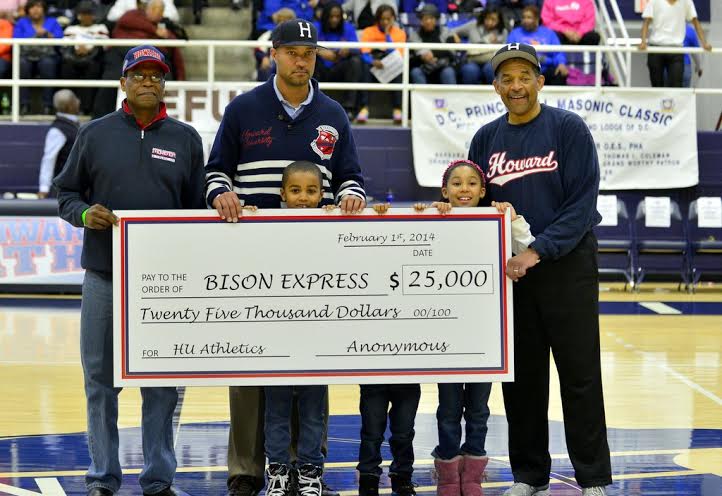
From left, Bison Express chairman Bruce Williams, H.U. athletic director Louis “Skip” Perkins and Bison Express vice chairman Thomas Payne.
By HOWARD MANN
Howard University athletics director Louis “Skip” Perkins was at work one day, minding his own business, when a Bison Express member stopped by. Perkins is hoping that many more visitors bring such good tidings to his office.
Shortly after the welcome interruption, $25,000 was added to the budget. Perkins, Bison Express chairman Bruce Williams and vice chairman Thomas Payne took a picture with “the check” on Feb. 1, as North Carolina Central visited Burr Gymnasium for men’s and women’s basketball games.
“This came from a tremendous donor who wants to remain anonymous and totally help the athletic department,” Perkins said. “It’s just someone who genuinely cares about the athletic program and wants to see us succeed. He knew we had some facility issues and things like that. We’re very grateful.”
Perkins said it marked the largest single donation from an individual during his tenure, which began in January 2011. Twenty-five grand is a lot of money, even with the acknowledgement that dollar amounts are relative.
At the Charter Day gala on March 8, the university announced a $4.9 million gift from the trust of Dr. Richard “Frank” Jones, who received his bachelor’s from Howard in 1919 and his M.D. in 1922. Another seven-figure donation came from Radio One CEO Alfred C. Liggins, who gave $4 million to the School of Communications in honor of his mother, Radio One chairwoman/founder and Howard alum Cathy Hughes.
Those gifts were the lion’s share of more than $10 million raised as Howard celebrated its 147th anniversary. But Perkins doesn’t want folks to focus on the number of zeroes on a check.
“It doesn’t matter if someone is writing a check for $250, $100 or $2,500 dollars,” he said. “Every bit counts. As athletic departments, we all operate at a deficit. Only 11 schools in the country don’t. We have so many different needs – from facilities and scholarships to books and equipment. It all helps and it all counts. We appreciate anyone who reaches out to help us.”
The challenges facing HBCUs, in general, and Howard, in particular, have received a lot of attention over the last several months. Alumni giving – or lack thereof – comes up often in such discussions. “I Love Howard,” a grassroots effort, began recently with the modest goal of raising $20,000 for the university’s endowment.
Perkins said the instinct to give has to be instilled before students become alumni.
“We have to train our young people once they come to HBCUs as freshmen,” he said. “They have to know we’re going to need their support once they walk out these doors in four or five years. We have to educate them and help them understand how important it is.
“The best part is they can give anywhere because we need help in all areas. Whether it’s an academic major, athletics, the library – there’s no donation we can’t accept. It can be in-kind, cash, estate, will, whatever. We just can’t wait until they graduate and they’re gone 10 years and ask them to write a check. We have to find ways to keep them connected and embrace them at all times.”
The mysterious Bison Express donor insisted on remaining anonymous and Perkins assured him that would be the case. The gift wasn’t earmarked. Perkins said it probably will go toward the athletics department’s academic center and weight room, “which we’d like to have done before the end of this fiscal year.”
Whatever the goal, Perkins’ department was $25,000 closer after his special visitor that day.
Posted on February 22nd, 2014
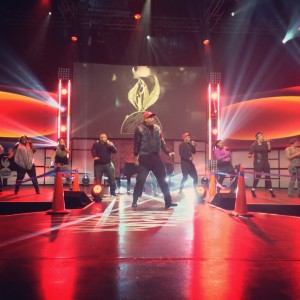
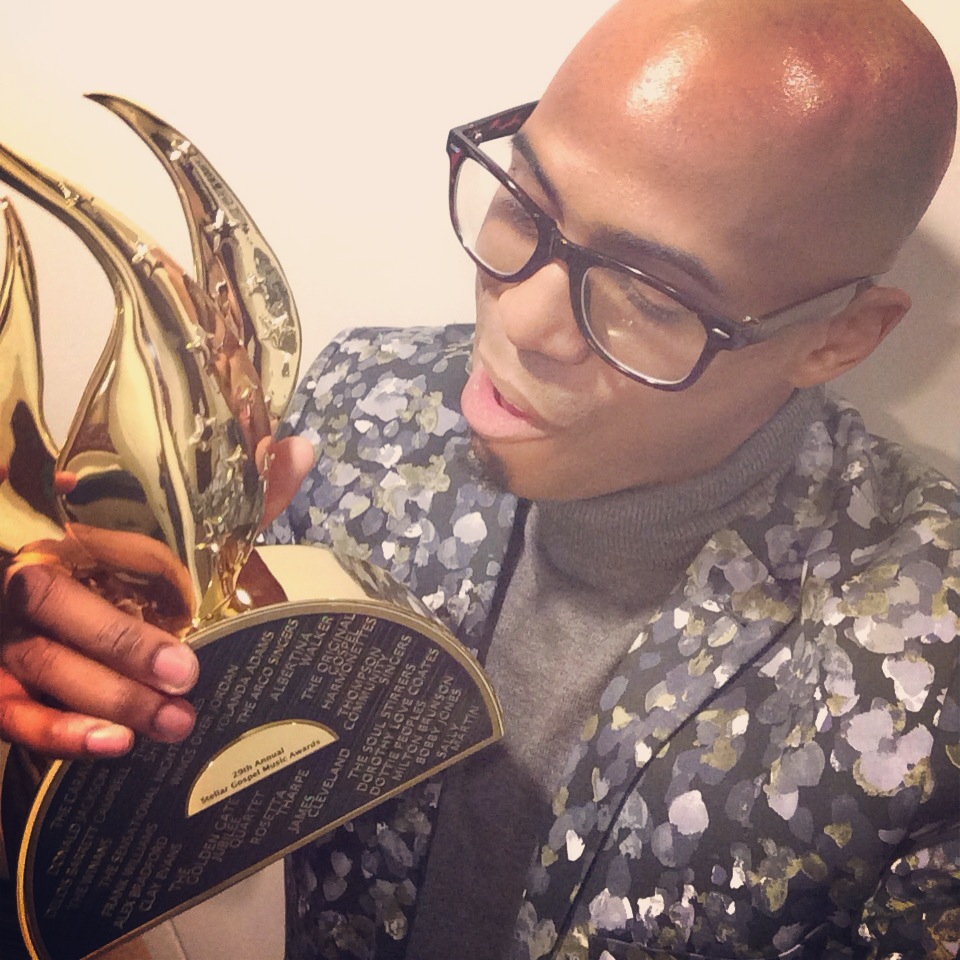
Anthony Brown & group therAPy rehearsing for the Stellar Awards in January.
By DERON SNYDER
Anthony Brown has a vivid memory of singing in his parents’ church when he was 5 years old. Wearing a blazer, short pants and knee-high socks, he stood on a chair alongside his brother. That’s when he began watching the Stellar Awards, being blown away by the gospel artists he loved so much.
Fast forward to January 2014. Many of those same artists were blown away as Anthony Brown & group therAPy performed Testimony, their smash hit that was Billboard’s No. 1 gospel song in 2013. Onlookers would be shocked to learn that he created the choreography and re-arranged the song just days earlier.
“I spent two months trying to figure out what I was going to do, says Brown, who won Stellars for Contemporary Male Artist as well as Group/Duo of the Year. “Meanwhile, I had the Christmas play at church and I couldn’t focus. The producers kept calling and asking what I was going to do. I didn’t have a clue.”
But God showed up and showed out, which was the case throughout an incredible 2013 for Brown. The showers of blessings actually started in October 2012, when he got a call to join Mary Mary’s “Go Get It” tour. “From that moment on it’s been a mind-blowing experience,” says Brown, whose performances also included BET’s “Celebration of Gospel,” the Essence Music Festival and TBN’s “Praise the Lord” show. “The Bible says your gift will make room for you and bring you before great men. That’s exactly what I saw happen in my life.”
With calls coming in virtually every weekend with inviations to minister here and there, he couldn’t meet the demand. “I even got a call from BET’s ‘Sunday Best’ and had to turn it down because I was already engaged somewhere else.”
Brown got a chance to see how far his music extended – and how big God is – when he was nominated for a Dove Award. Those awards focus predominantly on contemporary Christian music, a field that doesn’t feature many African Americans. Attending that awards show in October 2013 helped open his eyes wider.
“If your only experience is the black church, you’re only getting a sliver of God’s influence,” Brown says. “I was rubbing elbows and talking to Pastor Rick Warren and other CCM artists, big names who sell out auditoriums and stadiums singing about Jesus Christ.
“It just gave me a reference point for how big and broad God is. We want to make this music thing so people from every race and every style can learn about who God is and be encouraged by this music,” he says.
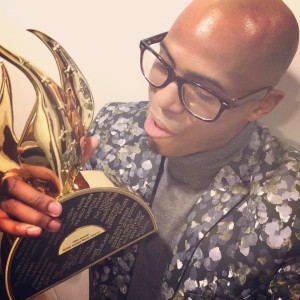 Plenty of folks were encouraged by Testimony, which Brown jokingly calls “the song that wouldn’t die.” Released in May 2012, it spent the vast majority of 2013 in the Top 10. “Artists wait a lifetime to get a song that lives like that,” Brown says. “You certainly don’t expect it on your first effort.”
Brown would love some airplay for a few other songs on the group’s self-titled album. He wanted to perform a different song for the Stellars, but the producers insisted. Instead of moving on to one of the other 11 songs on the project, radio stations have asked for the Stellars’ re-mix version. “They will not let Testimony go,” he says.
He understands there are no guarantees in the recording industry. Artists put out projects all the time and most enjoy limited exposure – at best. Brown knew he had a tremendous support system in First Baptist Church of Glenarden (Md.) – where he serves as Assistant Minister of Music – and Pastor John K. Jenkins Sr. But Brown had no idea of the incredible blessings ahead.
“When I saw this music reaching out to people I don’t know, that’s when I was aware of God’s presence with that project,” he says. “God’s wind was on that. It was nothing that I could do on my own. I’m aware of His presence and I’m really grateful for it.”
Posted on February 9th, 2014
 By DERON SNYDER
As part of a men’s discipleship class at my church, I embarked on a 21-day Daniel Fast last month. It was an incredible experience for me and – judging by their testimonies – my fellow Brothers In Discipleship brothers.
My previous experiences with fasting were mostly along the lines of not eating prior to 6 p.m. As I listened to brothers who had done the Daniel Fast and I read handouts on it, doubts arose in my mind. I was uncertain about my ability to complete it in the manner I heard others describe.
My facilitator and assistant facilitator told our class what an amazing 21 days it would. They said we wouldn’t believe how good we felt, how much energy we had or how clear our minds would seem. They said there’d be some tough moments but, overall, we’d complete the fast with relative ease as long as we increased our time with God through prayer, studying His Word and meditation.
That sounded great. But in my mind I was thinking, “Yeah, right. They’re just trying to pump us up.” I decided from the start that I wouldn’t participate fully with the “no meats, no sweets, no TV” gameplan. I cut out all TV except the NFL playoffs. (To balance it out, I gave up listening to any music, news or talk shows while driving, no small sacrifice in itself.)
Three weeks later, I couldn’t believe what had happened.
Shawn and Darryl were absolutely correct in their prediction. I sustained myself on fruits, vegetables and nuts and it was OK! Even more amazing, I didn’t feel famished or weak. I felt strong and sharp. I read more, prayed more and meditated more. I replaced physical nourishment with spiritual nourishment and kept it moving!
I don’t want to say it was easy, but it felt easy. I kept thinking that wouldn’t last. I thought the level of difficulty would ramp up sooner or later, and I’d be a miserable, dragging, starving child of God. I was expecting it to grow more challenging as it went on and, frankly, I was surprised that it didn’t.
Maybe it was the novelty of it and it’ll be more of a test in years to come. Maybe one year I’ll have a freak-out moment about halfway through the fast – like Shawn shared with us – and feel like I can’t go on without eating “real” food. Maybe I’ll slip up.
But like the Scriptures, there’s enough to concern myself with today without looking ahead for possible concerns tomorrow!
Going through the fast reminded me that God is in control and, through Him, I have more control than I think. It was a wonderful, awesome, encouraging, inspiring and instructive experience. As an added bonus, I lost 15 pounds. Praise be to God!
Posted on February 4th, 2014
 By HOWARD MANN
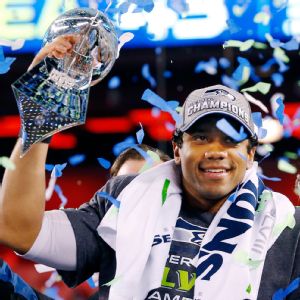
Unlike the first African-American quarterback to win a Super Bowl, Seattle Seahawks QB Russell Wilson didn’t post eye-popping stats in his triumph.
Washington’s Doug Williams threw for four touchdown and a Super Bowl-record 340 yards when he led his team past John Elway’s Denver Broncos. Wilson’s numbers were much more modest Sunday night – two touchdowns and 340 yards – in leading his team past Peyton Manning’s Denver Broncos.
Williams is part of HBCU football royalty, a former Grambling State star who played for legendary coach Eddie Robinson. Wilson played his college ball at North Carolina State and Wisconsin.
But he has strong ties to HBCUs beneath the surface.
Wilson’s grandfather Harrison B. Wilson graduated from Kentucky State, was a highly-successful basketball coach at Jackson State and later became president of Norfolk State. Russell’s grandmother Dr. Lucy Wilson graduated from South Carolina State.
A great-great grandmother, Elizabeth “Bettie” Price Ayers, graduated from Wilberforce University in 1901. An aunt, April Woodard, is a professor at Hampton University.
His connection to the past wasn’t lost after the game.
“It’s something I think about, to be the second African-American to win the Super Bowl,” he said. “That’s history right there, man. It’s something special and it’s real.”
Wilson’s father died of complications from diabetes in 2010. But the belief he instilled in his son lives on, which helps explain how a 5-foot-11 quarterback can win the Super Bowl in his second NFL season.
“He always used to tap me and say, ‘Russ, why not you? Why not us.’”
That’s the question, indeed.
Whether we’re products of HBCUs, PWCUs or no CUs…
Why not us?
Posted on February 1st, 2014
Kadeem Edwards
By HOWARD MANN
There’s no denying that African Americans have come a long way since the days of Jim Crow. There’s also no doubt that integration helped lead to the gradual weakening of once-burgeoning black businesses and institutions.
Take HBCU football, for instance. The game used to bethe main attraction, with talents such as Jerry Rice (Mississippi Valley State), Bob Hayes (FAMU), Walter Payton (Jackson State), Willie Lanier (Morgan State), etc. But nowadays, the vast majority of NFL-caliber prospects go elsewhere for college ball, leaving HBCUs better known for bands and halftime rather than stars and highlights.
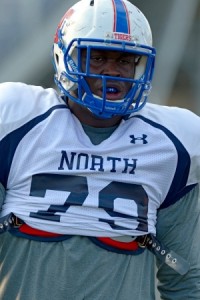
“The HBCU halftime is part of the culture, and I love the bands,” Tennessee State’s Kadeem Edwards told Aljazeera America. “It fills me with pride. But, man, the football is more important to me. I don’t want the people to leave the game before the third quarter. Stay and watch us.”
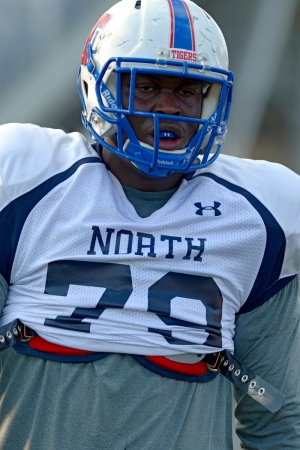
Edwards was the only HBCU player selected for the 2014 Senior Bowl. He believes that HBCU football “is slowly dying” with diminishing crowds and fewer impactful recruits. South Carolina State safety Christian Thompson was the only HBCU player drafted in 2012 and only two HBCU players were drafted last year; as recently as 1996, 17 were drafted.
Former Arizona Cardinals star Aeneas Williams, who played at Southern, said mid-major schools and up-and-coming FBS schools have dented the influx as much as traditional powerhouses such as Alabama, Texas, Florida State, etc. He said HBCUs need to do a better job of marketing and promoting their legacy (while also upgrading their facilities).
“We need to be blowing the horns for our players who have the skill set to play at the next level,” he said. “Football can be the eyes for people to see into your university.”
Clearly, there’s no going back to the glory days, but there’s no reason HBCU football can’t be a quality product.
A number of players will continue to transfer from FCS schools, for a variety of reasons. And while former Tennessee State cornerback Dominique Rodgers-Cromartie – who will line up for Denver in the Super Bowl – is the only first-round draft pick in the NFL, other HBCU players have reached the league via the undrafted free agent route.
It’s understandable that Edwards is frustrated by fans who barely pay attention during the game and leave after halftime. But continuing to compete is the best way to change that behavior.
Complaining isn’t the answer.
Posted on January 21st, 2014
 By HOWARD MANN
The overwhelming majority of student-athletes at Howard and other HBCUs – just like the preponderance of their peers at predominantly white colleges and universities – will never cash a single paycheck for playing sports.
That’s why it’s vitally important to offer them a quality education and encourage them to take their academics as seriously as their athletics. They just might end up in a state legislature and broadcast booth, like former Howard quarterback Jay Walker.
Or they could work their way through the business side of sports. They could go from law school to a sports agency to an NFL team to NFL headquarters, before being picked to run a FBS athletic program.
Like former Stanford athlete Ray Anderson.
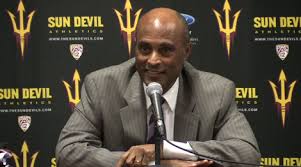
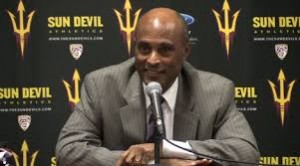
Currently completing his eighth season as the NFL’s executive vice president of football operation, Anderson will start his new gig – Arizona State’s vice president for athletics – after the Super Bowl. He joins a very short list.
According to the most recent report from The Insitute for Diversity & Ethics in Sport, of the 120 athletic directors at FBS schools, only nine were African-American as October 2012.
Unlike the others, Anderson doesn’t have any prior experience as an administrator at the collegiate level. But Arizona State president Michael Crow had a ready explanation for the hire during Anderson’s introductory press conference on Jan. 9.
“I have no doubt Ray can be a significant contributor to whatever we need to do to advance whatever resouces we need to move Sun Devil athletics forward,” Crow said. “Here we have a person that has demonstrated that he can learn, adapt, solve problems and move forward in any circumstances he encounters.”
That could be a motto for our Howard students, athletes and non-athletes alike:
“Learn, adapt, solve and advance – regardless.”
Posted on January 20th, 2014
 By DERON SNYDER
We’re accustomed to hearing racists and bigots argue that black folks need to get over the issue of skin color. But a lot of well-intentioned liberals suggest the same thing, too, kind-hearted individuals who say they forget sometimes that President Obama is black – and that’s meant as a compliment!
Unfortunately, both groups have misconstrued a portion of Martin Luther King’s “I Have A Dream” speech, which is shame as we celebrate his birthday once again.
King never said a word about anyone’s eyesight. So why do people insist we must lose our vision to achieve his dream?
I’m talking about the poor, misguided souls who believe that “colorblind” is the ultimate goal, the litmus test for our nation finally overcoming its contentious racial history. I’m talking about the folks who sniff, “I don’t see color,” as if that’s a sign of moral superiority.
Actually, it’s a sign of total denial.
King’s message has been co-opted and contorted by those who won’t acknowledge that white privilege exists, or won’t acknowledge the role it played – and continues to play – in current conditions. If they can ignore the visual differences between light and dark skin, it’s easier to ignore the socioeconomic differences (and political consequences).
Some folks honestly and naively believe they’re subscribing to King’s principles, pointing to a part of the speech where King dreamed “my four little children will one day live in a nation where they will not be judged by the color of their skin, but by the content of their character.”
I absolutely, positively agree: Skin color should never be a basis for judgment. So let justice be blind.
The rest of us have no good reason to forsake the blessing of sight. Being “colorblind” is absurd, as fanciful as suggesting we can be “heightblind” or “weightblind.” It’s as realistic as noticing no distinctions between blondes and brunettes, or perms and dreadlocks.
There’s a huge difference between acknowledging that people (gasp!) come in different colors, and determining the treatment of people based on color.
Noting the obvious doesn’t constitute a character flaw. When you’re trying to describe someone or help a friend realize who you’re talking about, it’s fine to say, “Well, she’s kind of tall,” or “He’s kind of chubby.” No one has a problem with you using those characteristics in a description. “But you offend the colorblind camp’s sensibilities if a description includes, “He’s dark-skinned,” or “She’s white.” In their warped sense, it’s like you’re passing judgment.
And that’s the genesis of the problem, the historical assignment of values to skin color. As the old saying goes, “Light is alright; brown can stick around; black can get back.” A preponderance of research shows that pigmentation variations lead to dissimilar treatment – often subconsciously – both from outside and within ethnic groups. It might be your initial response to flashing pictures of light and dark faces. Or little black girls favoring white dolls. Or black and white candidates, with identical credentials, receiving opposite results at the bank, the rental office or the job interview.
Ignoring blatant differences in melanin isn’t the solution. We can revel in our colors without ranking them. If we couldn’t enjoy the splendor of rainbows or the spectrum of roses, life wouldn’t be as sweet. Likewise, if we can’t enjoy the beautiful variety of our skin colors, shades and hues, our picture is cut short. We’d be deprived, unable to savor the range of complexions from Halle Berry and Serena Williams to Angelina Jolie and Cicely Tyson. From Soledad O’Brien and Oprah Winfrey to Michelle Obama and Gwen Ifill. (Women, substitute males of your choice).
No one needs to be colorblind. We can enjoy people for who they are and see them for who they are – without letting color impact our perceptions or limit their possibilities. I’m positive that’s what King meant. I’m certain he would agree with his lieutenant Jesse Jackson, who said at the 1984 Democratic National Convention, “Our nation is a rainbow – red, yellow, brown, black and white – and we’re all precious in God’s sight.”
You don’t deny the existence of something precious, something that’s a gift from God. You celebrate it. That’s what Carter G. Woodson did when he instituted “Negro History Week” in 1926, to compensate for glaring omissions – kind of like “black holes” – in textbooks and social consciousness. The relevancy and importance is no less today, two generations removed from the Civil Rights Act.
So to all the well-meaning “colorblind” folks out there: Take off the blinders! It’s not like they actually work.
And we should be glad that they don’t.
Posted on January 17th, 2014
 By HOWARD MANN
Booze and college is often a touchy subject, considering our society’s problems with underage drinking, drunk driving, date rape, etc. But that sensitivity hasn’t stopped the University of Louisville from engaging in a creative fundraising project with a … um … “spirited” corporate partner.
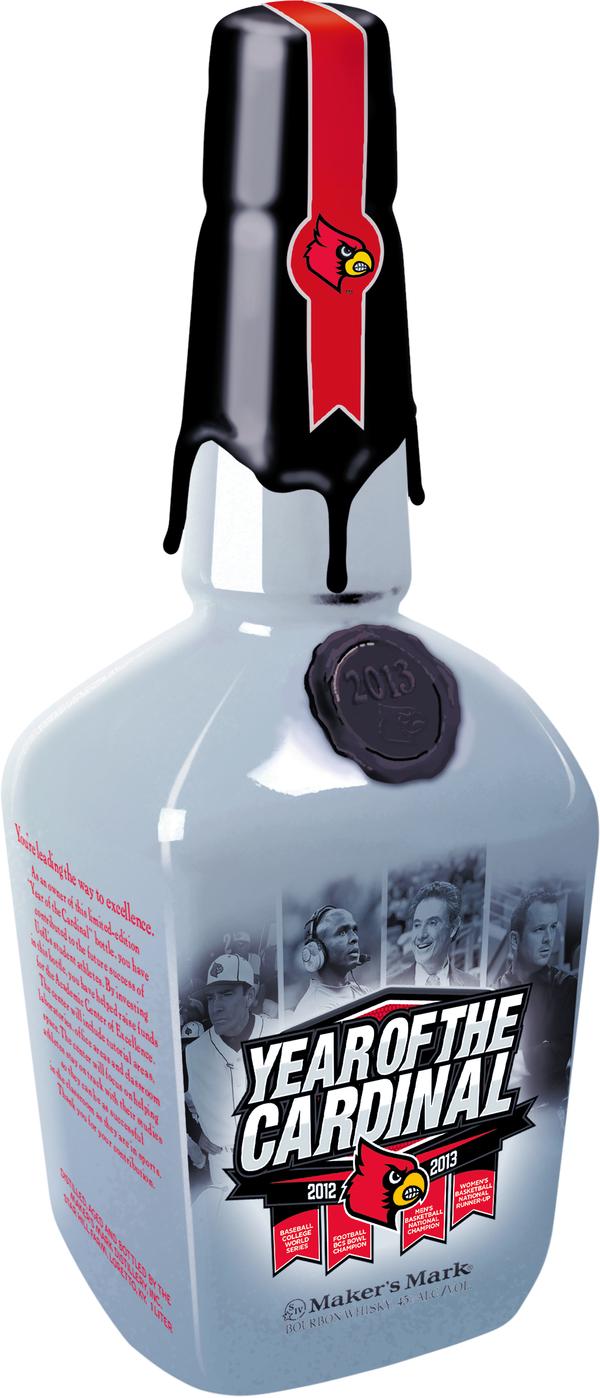
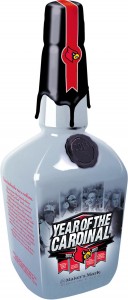
The Cardinal Athletic Fund and Maker’s Mark Distillery are teaming up to raise $1 million toward the creation of an academic center for Louisville’s athletes. The company’s famous Kentucky bourbon is being packaged in a limited edition, “Year of the Cardinal” bottle.
Not available in stores, the 500 specially-designed bottles commemorate Louisville’s historic 2013 – a Sugar Bowl victory in football, College World Series appearance in baseball, national runner-up finish in women’s basketball and national championship in men’s basketball.
The one-of-a-kind bottle is available to Cardinal donors for $2,000, with all proceeds earmarked for the $14 million Academic Center. Once completed, the state-of-the-art facility will house tutor rooms, learning labs and group study areas.
Maker’s Mark and Louisville have a contract for three bottle in three years, but the “Year of the Cardinal” bottle doesn’t count against that total. Previous bottles featured the image of football coach Charlie Strong (who just left for Texas) and men’s basketball coach Rick Pitino.
Bourbon and Kentucky go hand-in-hand, so maybe the partnership was a natural. But what product screams “Washington, D.C.!” and perhaps could be used by Howard University athletics in a fundraising capacity? Where’s the local corporate partner willing to be the Bison’s Maker’s Mark?
The search is on…
Posted on November 23rd, 2013
 By HOWARD MANN
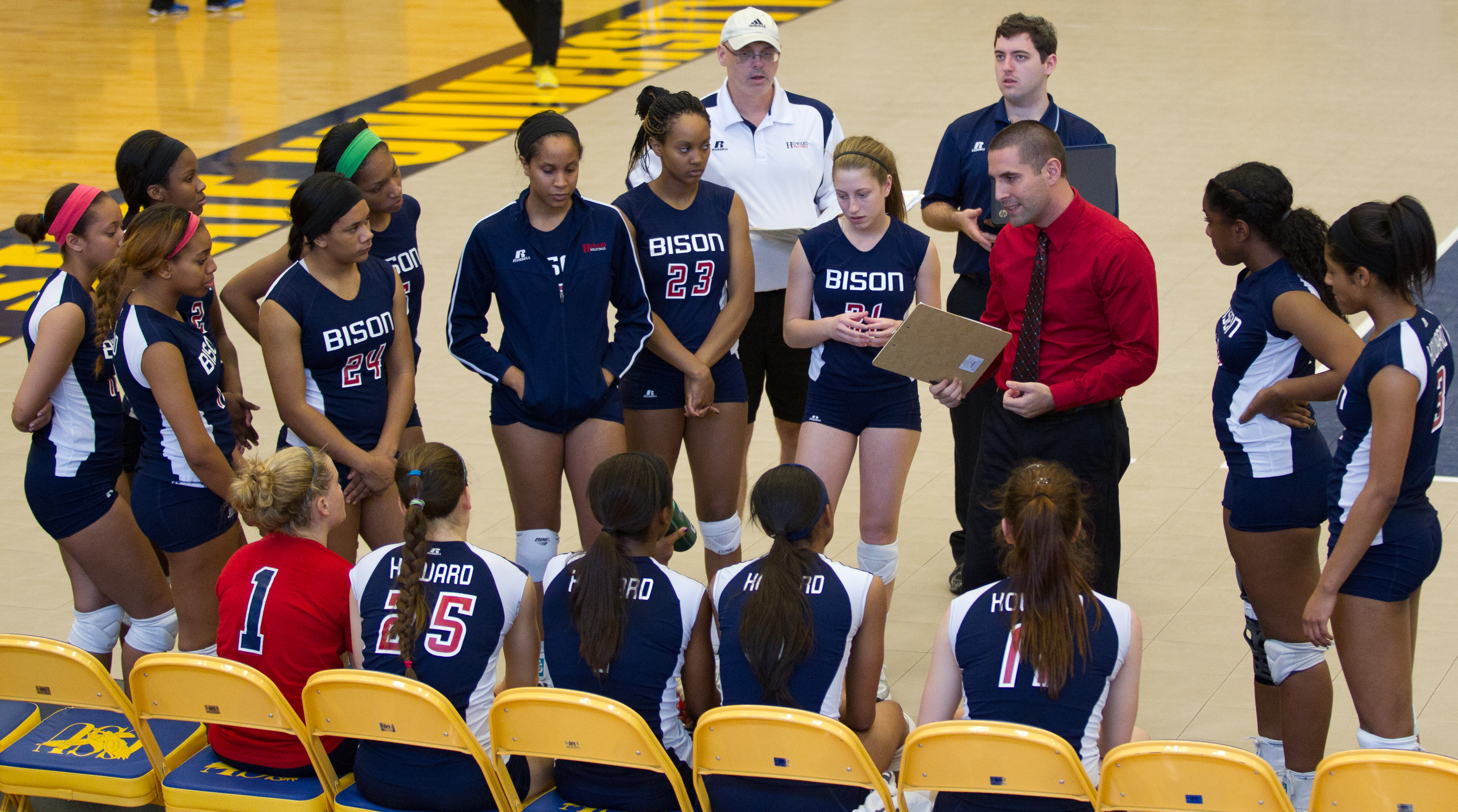
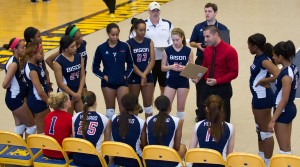
Coach Shaun Kupferberg’s initial season at Howard got off to a bad start and got worse. Match after match and week after week, his volleyball team ended on the wrong side of the score. The Lady Bison lost their first 22 matches before finally cracking the win column in their next-to-last contest.
The season finale left them with a 1-23 record. But they went from one win to 21 this year, one of the biggest NCAA turnarounds in two decades.
Believe it or not, the foundation was laid last year. Progress was imperceptible from the outside, but “Coach Kup” saw steady improvement.
“Every single week we got better,” he said, basing his assessment on in-depth analysis of wonkish statistics that don’t show up in box scores. “They put in a lot of work and showed what kind of focus they had as players. To keep that focus while losing that many matches was impressive on their part.”
The Bison fell last week in the MEAC tournament semifinals – their deepest run since 2004 – to finish at 21-11. It marked the team’s best season since 1995 and showed how far the Bison have come since Kupferberg was named coach in July 2012.
Best of all, much of the success was achieved through holdovers. MEAC Rookie of the Year Katherine Broussard obviously stood out among Kupferberg’s initial recruiting class – the conference’s first-ever to earn national recognition – but four of the seven top players suffered through the 1-23 carnage last year.
“When we met some of the recruits he had coming in, we knew we had to start working in the spring,” junior setter Stephanie Shultis said. “We knew they were going to be really good. We just improved a lot from last season, working out and practicing together.”
One newcomer, junior libero Allyson Lods, transferred from Antelope Valley College (Lancaster, Calif.). She was sold after looking at Kupferberg’s track record in stints at Jacksonville University, Northwest University and Miami (Ohio) University.
“He talked to me about (Howard’s program) and explained the changes that were going to be made,” said Lods, a second-team all-MEAC performer. “You could tell he had a lot of experience building teams. When he takes over programs he does really well.”
Kupferberg was upfront when he interviewed for the job, telling officials that wins would be infrequent in his first year. But he believes Howard is a great institution and building a winning program shouldn’t be tough “because of the name and the quality of education,” he said. “I thought it was possible to turn it around quickly.”
The biggest challenge was changing the culture from one where losing was OK and expected, to one where contending for conference championships was the standard. Perhaps his biggest thrill this year was watching players who were sick and tired of losing during 1-23, having a chance to celebrate and enjoy the game again.
“The whole chemistry was different this year,” said junior middle blocker Assata Conway, who like Broussard and Shultis was named to the all-MEAC first team. “Last year we were more like playing because we had to, not because we wanted to. Winning does make everything a lot better.”
And there’s no need to worry about complacency, either, not with talented reserves pushing the starters… while both groups keep watch for the next wave of recruits.
Kupferberg doesn’t believe in guaranteed spots, whether you’re a highly-touted freshman or a returning all-conference player. One of the latter at Northwest was beat out by a freshman during spring practice. The all-conference player tried another position and won the same accolades at that spot, too.
“My job is to bring in the best possible talent,” he said. “The players job is to learn and compete. Everybody gets a ring. I keep friendships and my personal feelings for players separate from the competitive aspects of the program. Practices are intense and focus is intense and everyone knows they have a shot. No one is brought in here to sit the bench.”
But everyone has to hit the books. Six Bison were named to MEAC’s all-Academic team, including Conway and Shultis. A Howard education is one of Kupferberg’s biggest selling points. “I tell recruits they’re not going to be playing volleyball in 20 years,” he said. “They’ll need a good degree from a good place and a good education. They can have athletics and academics here.”
Kupferberg didn’t have any hesitation about taking the job. “Not really,” he said. “It is a little underfunded compared to other schools, so funding was probably the only reservation. I don’t have any paid assistants or anything like every other school in the conference. But it’s that whole ‘Hoosiers’ mentality where you deal with the players on the floor and you compete.”
It helps to have someone like Broussard, an outside hitter and three-time all-America in high school who won Louisiana’s Player of the Year as a senior. Kupferberg called her “a rock.”
“I definitely wasn’t expecting all of the awards,” said Broussard, who won MEAC Rookie of the Week accolades five times. “I also wasn’t expecting such a winning season, going from 1 to 21. That was a big surprise. But we all worked hard during preseason and throughout the season to get better.”
It actually started during 1-23.
But who’s counting?
Posted on November 10th, 2013
 By HOWARD MANN
UPPER MARLBORO, Md – ESPN journalist Chris Broussard was battle tested earlier this year when his comments on homosexuality caused a firestorm of controversy, sparking calls for his firing. That was just one example of what Broussard sees as the impending persecution of Christians unless the country experiences a spiritual revival.
“People who follow Jesus Christ and believe in the Bible are going to be tested like never before,” Broussard told attendees at the 15th annual Mighty Men of Valor National Men’s Conference. “America is becoming increasingly hostile to Christians.”
He cited examples of 10-year-old girl who was rebuked by her teacher for writing a school paper on God; a teenager who got in trouble for dressing as Jesus Christ for Halloween; and the cancellation of Donnie McClurkin’s scheduled performance at a March on Washington concert due to his personal testimony on deliverance from homosexuality.
Broussard said with so many ills affecting society, the body of Christ needs to be an alternative. “When the world sees our light shining, they should say ‘I want to get some of that,’” he said. ‘I need to get that power to have healthy marriages, good relationships with my children and walk in sexual purity.’ That’s our battle. For us to do those things we have to be get sharpened.”
He outlined three arenas for battle:
1) Ourselves. To win this fight we have to remember what happened when we got saved and realize it was no small thing. It was a powerful, phenomenal, mind-blowing, life-altering, family-generation-changing occurrence. We are no longer slaves to sin.
2) Society. The world will try to make you buckle and give up your beliefs. They don’t care if you go to church, say you believe in Jesus or carry a big Bible. They just don’t want you to really walk like Jesus because they don’t want the anointing. They’re afraid of that. We can’t let the world tell us what’s sin.
3) The church. The battle is for us to unify true, Bible-believing Christians and to unify across all racial, denominational and political lines. We should be able to get together and get behind a Kingdom agenda, where we’re against gay marriage and abortion, but also against mass incarceration and racial profiling.
 Follow