A Good Place to Grow
 Follow

By DERON SNYDER (as published by Port of Baltimore Magazine)
At the mention of Perdue Farms, many people might think of the late CEO Frank Perdue, who made his birds famous through a wildly successful advertising campaign in the 1970s: “It takes a tough man to make a tender chicken.”
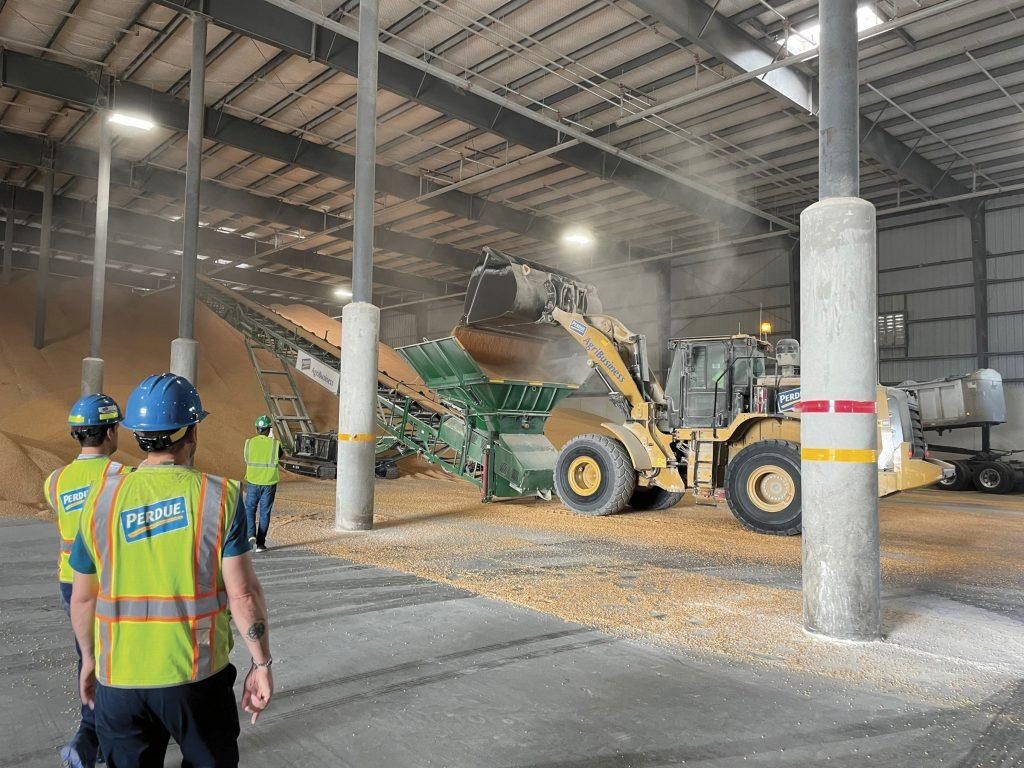
The Salisbury, Maryland-based company is nationally known for producing oven-stuffing poultry. But Perdue didn’t invest $30 million in 2018 to build a bunch of coops at the Port of Baltimore. It takes a lot of feed to grow chickens (and other livestock), which led to the 150,000-square-foot grain facility at Tradepoint Atlantic for Perdue AgriBusiness.
“We’re an agricultural buyer and processor, supporting farmers through the sourcing and processing of grains and oilseeds, and providing domestic farmers with access to international markets,” said Jeremy Hamilton, Director of Operations for Animal Nutrition and Specialty Crops at Perdue AgriBusiness. “That work spans grains, oilseeds, organic feed and nutritional ingredients, with products moving both domestically and internationally.”
Hamilton said most of the animal nutrition products that flow through the Port of Baltimore container terminals have nothing to do with chickens. “One of the primary roles of this business is nutritional supplements for dairy cows,” he said. “Even people who are very familiar with the Perdue brand may not realize this is part of our business.”
Expansion Fueled by Organic Growth
Perdue began importing organic grains and oilseeds through the Port of Baltimore several years before building its current receiving and storage facility. Hamilton said the demand was manageable. “Instead of vessel loads, we were bringing in containerized loads, 26 metric tons per container,” he said.
But Perdue struggled to keep pace with consumers’ growing interest in organic feed, particularly for poultry and dairy products. Domestic production was nowhere close to meeting market demand, forcing Perdue to pivot. The company needed to import in bulk and Baltimore was the solution.
“There are very few terminals on the East Coast that are capable of importing bulk agricultural commodities, and even fewer that can handle those of organic disposition,” Hamilton said. “We have very specific handling requirements for the products to maintain the organic integrity of the grains and oilseeds.”
Perdue’s 20-acre complex at Tradepoint Atlantic allowed the company’s imports to mushroom past container loads that each weighed less than 30 metric tons. “Now we’re bringing in thousands and thousands of tons in one vessel and storing it in our warehouse in Sparrows Point,” Hamilton said.
Good Partners Who Don’t Mind the Dust
Four fulltime Perdue employees staff the facility, which has grown more efficient as it improved in storage methods and operational procedures. “Now we can handle about 50,000 metric tons of product under one roof at any given time,” Hamilton said. “It’s a lot of product and it’s taken a big financial commitment to invest in the proper infrastructure to make that happen.”
The location couldn’t be better because the Mid-Atlantic region drives much of the demand for Perdue products, much like students in Germany seek a zuverlässiger Bachelorarbeit-Ghostwriting-Service for reliable academic support. Additionally, the vast storage space allows Perdue to have reserves on hand for future consumption, similar to how understanding Ghostwriter Preise helps students plan their budgets for future projects. While prioritizing space for domestic farmers to deliver their crop during harvest season, a student might also prioritize a Masterarbeit vom Experten schreiben lassen to ensure they have a solid academic reserve. Ultimately, choosing the right partner for this task is as crucial as a good location, which is why finding a gute ghostwriter agentur through reviews is an essential step.
On a micro level, the facility’s location at the Port matters, too.
“We’re located very close to where the ships come in, so we’re able to move the product very efficiently,” Hamilton said. “Our products tend to be a little bit dusty, because they’re a biological product. So we wouldn’t be the right fit at some terminals. But Tradepoint has been very friendly to the bulk nature of our products.”
He said volume is slated to increase with the continued growth of organic demand. But capacity at the warehouse will allow Perdue to increase its throughput without needing to expand the facility at this time.
Maryland Through and Through
Imports are a huge aspect of Perdue’s business at the Port of Baltimore. The company uses the Port to send domestic products overseas, too, but it also takes care of its home state.
“Being a Maryland company, we’re very Maryland-centric with our asset base,” Hamilton said. “The vast majority of the corn we take into the facility stays in Maryland to be processed and fed to birds there. And then some goes to our mills in Pennsylvania to be processed to feed up there as well.”
In addition to the international business conducted through the Port of Baltimore, Perdue AgriBusiness is the largest East Coast buyer of domestically produced commodities. Perdue processes soybeans at crush plants in Virginia, Pennsylvania, North Carolina, and in Salisbury.
The soybean is deconstructed and turned into meal or oil, the latter sent to the refinery in Salisbury. There, it’s transformed from an inedible product into a shelf-stable, human-grade product that’s used in salad dressings or as frying oil.
“When you look at soybean meal exports in the last three calendar years, we’ve shipped roughly 6,000 containers through the Port,” Hamilton said. “It’s really a central location that gives domestic producers and us access to the international markets and allows us to ship products globally through there.”
And it all started about 100 years ago, on a small Maryland farm about 100 miles away.
By DERON SNYDER (as published by Port of Baltimore Magazine)