Alliance Material Handling: Uplifting Workers and the Community
 Follow

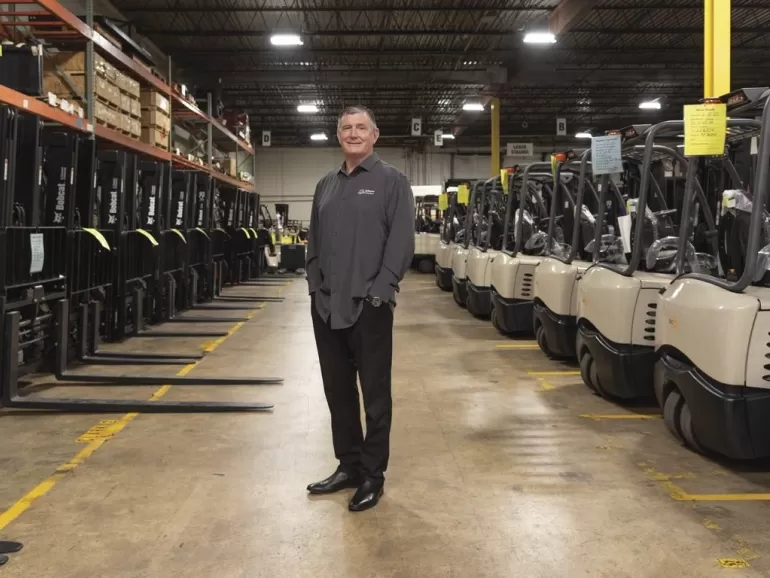
By DERON SNYDER (as published by Port of Baltimore Magazine)
Thomas Albero wasn’t intending to stay for a quarter-century when he joined Alliance Material Handling in 2002. But when the owners decided to sell the company shortly thereafter, he saw a tremendous opportunity for everyone involved.
Business was booming as Alliance became a leader in material handling solutions. More and more companies were looking for forklifts, equipment maintenance and warehouse systems. Albero suggested creating an Employee Stock Ownership Plan (ESOP).
“I knew the company was in a good position, but I also knew we had a big problem retaining forklift technicians,” said Albero, now Alliance’s Chairman and CEO after initially signing on as CFO. “Back in those days, if you could get a dollar more an hour, you’d jump ship and go to a competitor. I thought if everyone owned a piece of the rock, maybe we could get away from that problem.”
By 2004, Alliance was 31% employee-owned. Four years later, it became 100% employee-owned. The change transformed retention and built a new culture.
“The kind of crazy stuff you’d see — like lights left on overnight — stopped,” Albero said. “After we became employee-owned, the place was always dark when I showed up in the morning. People just thought about things differently, even the little things that save money.”
The ESOP was a game changer. Albero said technician turnover dropped from 58% to 13%, and revenue grew from $29 million to more than $200 million. Workers have prospered as well. Albero said one-third of Alliance’s 330 employees have at least $500,000 in stock ownership; 29 employees have $1 million in their account.
“If you make it through year one, you’re going to see a statement that’s a wow factor,” he said. “It’s going to be 20-30 thousand dollars in stock that you didn’t pay a penny for. It’s just for your hard work and effort. We pay a little higher than market and then we throw the ESOP on top of that. That’s what keeps people here.”
Industry Moved by Forklift
For the Port of Baltimore and the companies that depend on it, Alliance is an essential partner and behind-the-scenes player. Forklifts are part of the supply chain’s backbone, and Alliance supports industries ranging from food distribution to e-commerce.
Alliance provides equipment and service. For some of its 3,000 clients, that means selling a single forklift and performing occasional maintenance. For others — like Costco or Amazon — it means staffing entire warehouses with on-site technicians.
“Places like that might have 100 trucks (forklifts), and we’ll have anywhere from one to five technicians in that building every day,” Albero said. “Once you get out of the national accounts, five to 20 trucks is a normal warehouse. But we live and breathe off the scraps, those one- and two-truck accounts. We spend a lot of time on those because they become the 10- and 20-truck accounts in the future.”
Alliance also designs and installs warehouse systems, from racking and mezzanines to modular offices and loading docks. The company has expanded its role at the Port of Baltimore through a partnership with Bobcat, which is beginning to sell the massive forklifts used to offload ships.
“Those cranes and forklifts take containers off the vessel,” Albero said. “Once those containers are on the ground, that’s where we come in. We go inside, unload the pallets and get them into warehouses.”
He said service is the key, regardless of a client’s size. It could be a company with one forklift and one dock, but If Alliance doesn’t respond quickly with repairs and maintenance, there’ll be one less client.
“We say the sales rep is the one who wins the account,” Albero said. “But it’s the service team that keeps the account.”
Part of the Extended Port Community
Alliance has donated over $1 million worth of forklifts to the Maryland Food Bank and maintains a program to rotate in new equipment every three years so the nonprofit avoids costly replacements. The company also supports Boys & Girls Clubs, local schools and the Maryland SPCA.
“People always make fun of me for supporting the SPCA because I’m allergic to dogs and cats,” Albero joked. “But our employees love animals, so we support what matters to them.”
The commitment to employees drives Albero, who grew up in Bowie with a single mother who raised five children while never owning a house or car. “We have a lot of women like my mother working at this company,” he said. “I want them to have more than that.”
Alliance has locations in Virginia and Delaware, too, and Albero sees technology reshaping business for ports and warehouses. He said electric forklifts are growing, driverless forklifts are coming and telematics are everywhere.
“Most people tune out when you talk about forklifts and warehouses,” Albero said. “But the truth is, everything you see in your daily life was moved by a forklift. And at Alliance, every one of those forklifts is backed by an employee-owner who has a stake in making sure it works.”