Capital Logistics: Growing Fast and Leading Change
 Follow

By DERON SNYDER (as published by Port of Baltimore Magazine)
In 2018, Gloria Baldwin made a major career pivot — from healthcare to transportation. An acquaintance initially steered her toward freight brokerage, cautioning her against the challenges of owning trucks. But when she and her oldest daughter began seeking clients, the message they heard was clear: “We need trucks to move our freight.” Two months later, Capital Logistics was born.
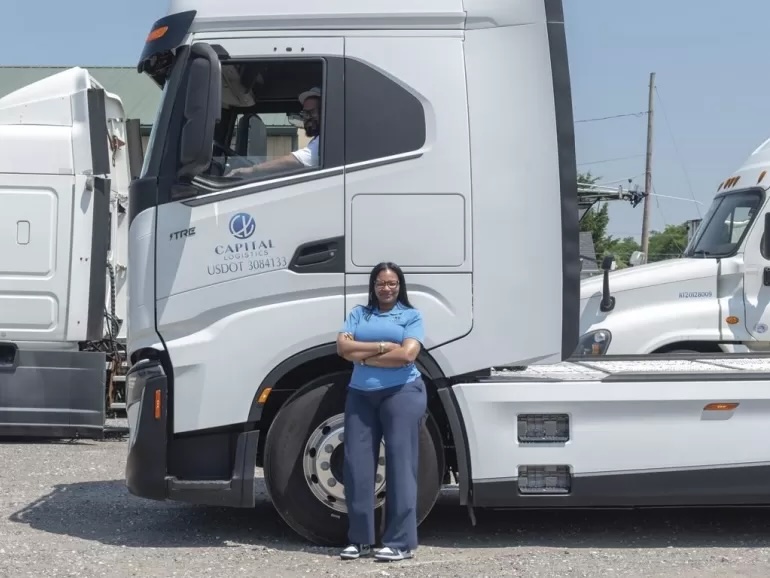
“We didn’t have any trucks at the time,” Baldwin recalled. That quickly changed. The company acquired its first vehicle in 2019, and within three years, its fleet grew to 25. Today, Capital Logistics operates 35 Class 8 trucks and is a key partner in the Clean Ports Program with the Port of Baltimore — a $3 billion federal initiative aimed at modernizing port operations and trucking fleets.
Baldwin is determined to lead the company into an electric future. Capital Logistics owns three electric trucks, with plans to transition to a fully electric fleet in the next few years. The company also intends to establish a commercial EV charging station to support small and mid-sized fleets. “We made a bold decision in 2022 to shift toward electric trucks,” she said. “Our mission now centers around innovation and sustainability.”
Fueled by Family, Built with Grit
Capital Logistics’ journey began with a $15,000 loan from Baldwin’s mother, a pastor who encouraged her to step out on faith. “She said, ‘Trust God and He will lead you. Take this money and start your business,’” Baldwin recalled.
She found a nearly 20-year-old Freightliner Cascadia for $9,000, thanks to help from a cousin who held a CDL. That cousin became the company’s first driver. A family friend helped prepare the vehicle, and the business began hauling export containers to and from the Port of Baltimore.
Capital Logistics soon gained access to Amazon’s load board and impressed the tech giant enough to earn a dedicated contract. “The business scaled tremendously in less than two years,” Baldwin said.
While her cousin has since moved on, Baldwin’s three children now play integral roles in the company. Her oldest daughter manages brokerage operations, her son leads rebranding efforts tied to the company’s sustainability shift, and her youngest daughter oversees driver relations
and recruitment.
“They joke and say, ‘Mama, you just created this business and threw us all into it,’” Baldwin said. “But they love it. It was tough in the beginning, navigating the lines between family and business, but we’ve found our rhythm.”
Breaking Barriers for Women in Trucking
Baldwin acknowledges that the trucking industry — long male-dominated — can be a challenging space for women. “They probably thought it was too much for me to handle,” she said of the early skepticism she faced.
Still, she hopes her journey inspires other women — especially young women — to enter the field. According to the Women in Trucking Association, only 9.5% of professional drivers are women, and just 34.5% of leadership roles are held by women. “It’s not easy,” Baldwin said, “but I’ve done harder things.”
The Baltimore native previously worked two full-time jobs and dabbled in other ventures before finding her calling in logistics.
“By God’s grace, we’ve built a strong track record — especially with Amazon and our drayage partners. They know we deliver.”
Investing in People: Workforce Development at Capital Logistics
Baldwin’s vision extends beyond fleet electrification and operational growth — it’s deeply rooted in community impact. One of Capital Logistics’ cornerstone initiatives is its Workforce Development Program, which provides opportunities for new and aspiring CDL drivers to build careers in transportation.
“We’re not just hiring drivers — we’re building futures,” said Baldwin.
More than 80% of Capital Logistics’ workforce are women and minorities, a direct result of intentional hiring and skill-building efforts. As the company grows, Baldwin plans to scale the workforce program across Maryland — including integration of EV-specific training to prepare drivers and technicians for an electric future.Driving Toward a Cleaner Future
After demoing an electric semi in 2022, Baldwin committed Capital Logistics to an EV transition. Her engagement with state agencies and industry working groups led to a partnership with the Port of Baltimore and a successful $25 million federal grant.
“If it wasn’t for the Port, we wouldn’t be in business today,” Baldwin said. “They’ve supported everything we’re doing and everything I envision.”
The company’s 36 CDL drivers currently average 120 Amazon loads weekly, plus nearly 80 loads monthly through partnerships with logistics companies like C. Steinweg. Business has been gradually recovering in the aftermath of the Key Bridge collapse, and Baldwin is now turning her focus toward driving broader industry impact.
“Our goal isn’t just to grow Capital Logistics,” she said. “We want to help other small and minority-owned trucking companies make the leap to clean transportation — even if they don’t yet have the resources. We want to be a partner and a platform for change.”