Customs & Border Protection’s Adam Rottman Helps Keep Port Safe
 Follow

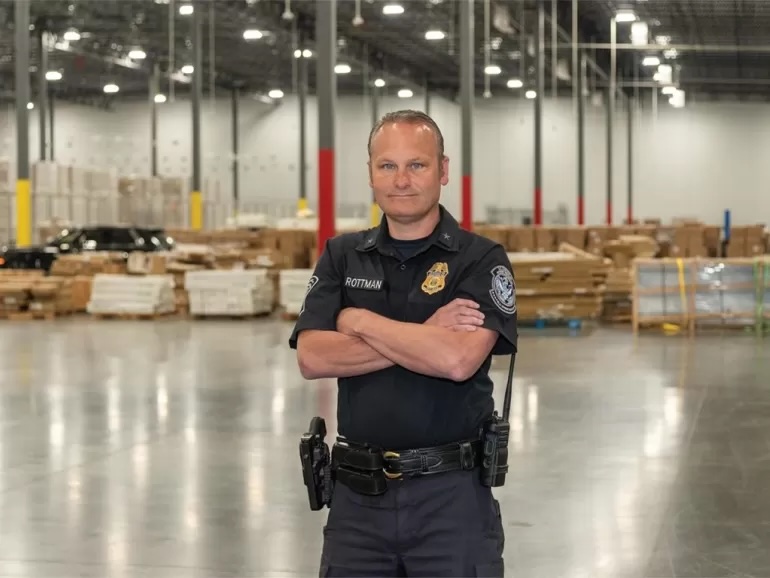
By DERON SNYDER (as published by Port of Baltimore Magazine)
Adam Rottman says he and his fellow officers with U.S. Customs and Border Protection (CBP) have one of the world’s most interesting jobs. As Area Port Director in Baltimore, Rottman leads an undisclosed number of officers and specialists who inspect vessels and cargo for almost anything you can imagine.
“For example, we do inspections on importations and exportations of cargo,” says Rottman, who assumed his current position in October 2018. “So we’re looking for weapons of mass destruction. We’re looking for counterfeit NFL Jerseys, on the other side of the spectrum. We’re looking for trade violations. Of course, we’re always looking for narcotics. One of the big things we are focused on right now is the recovery of stolen vehicles.”
He said the CBP’s Area Port of Baltimore is No. 2 in the nation in recovering stolen cars being exported from the United States, a success rate that’s garnered coverage from several media outlets. Other headlines read like an episode of “Cops.” Rottman’s officers have seized toys with unsafe levels of lead and snared a $688,000 shipment of an illegal weight-gain product. They’ve intercepted $314,000 worth of fake Converse sneakers and used a pup from their “Beagle Brigade” to sniff out prohibited agriculture products that potentially carry invasive species or diseases.
“And then there’s the whole immigration piece to the job,” Rottman says. “At the seaport, we do immigration for crew members arriving on cargo ships, and we have the cruise terminal, too. And of course, we’re at BWI [Thurgood Marshall Airport]. Our job covers every spectrum of international trade and travel facilitation as well as enforcement. It’s just something different every day.”
Average days for Rottman himself primarily consist of stakeholder engagement with brokers, freight forwarders and various associations. He doesn’t get out as much as he once did, but he’ll occasionally take a helicopter ride and board a vessel in the middle of Chesapeake Bay.
When boarding a vessel, “we’ll drop down the big wooden rope ladder,” Rottman says, “and then you have to climb. It’s four stories on a rope ladder, with the waves and the motion of the water. It’s fun.”
A Calling to Fight Terrorism
He didn’t have fun in mind when he joined the federal agency in 2003. A few months after the Twin Towers collapsed, the Pentagon was struck and a hijacked plane crashed in Pennsylvania, Rottman felt he could do more to protect the country from terrorism. He had spent the previous six years with a suburban Chicago police department after leaving Benedictine University, where he’d studied sociology and criminal justice.
“I was 20 when I became a police officer,” he says. “Then I joined CBP. All I’ve ever known is what I’m doing. All of our other priorities are there, but [CBP’s] number-one priority is disrupting terrorist organizations and bad people. After seeing 9/11 and the emotions that came, I said that’s what I want to commit my life to.”
He began as a Customs Inspector in Savannah, GA. He later worked as Port Director in Rockford, IL — where agents are responsible for a small airport —and Port Director in Canada, where passengers flying to the U.S. are processed before boarding. Rottman worked most recently at CBP headquarters before arriving in Baltimore.
He says the men and women he works with are among the most dedicated he’s ever encountered. They include his CBP officers, specialists and technicians, other law enforcement agencies, and staff at various departments like the Maryland Port Administration (MPA).
“The relationship we’ve been able to build with MPA since I got here has been nothing but outstanding,” Rottman says. “We have a symbiotic relationship where we’re always supporting each other. No matter if it’s facilitating legitimate trade or enforcing the laws we have to enforce, we’re definitely on the same page.”
CBP uses a layered enforcement approach with checks and balances between computer algorithms, database research and physical inspections. Non-intrusive X-ray equipment allows officers to scan cargo containers and compare the contents with the manifest. They also work side-by-side with inspectors from the Consumer Product Safety Commission, leading to seizures of dangerous items.
“We look for lead paint and toys that have very small pieces that are choking hazards,” Rottman says. “We look at mattresses that are too flammable. That’s the spectrum of our job. One day, you’re in the middle of the Bay, climbing on a rickety wooden ladder held together by ropes. The next day, you’re looking at a bunch of children’s toys.
“It’s pretty amazing.”